


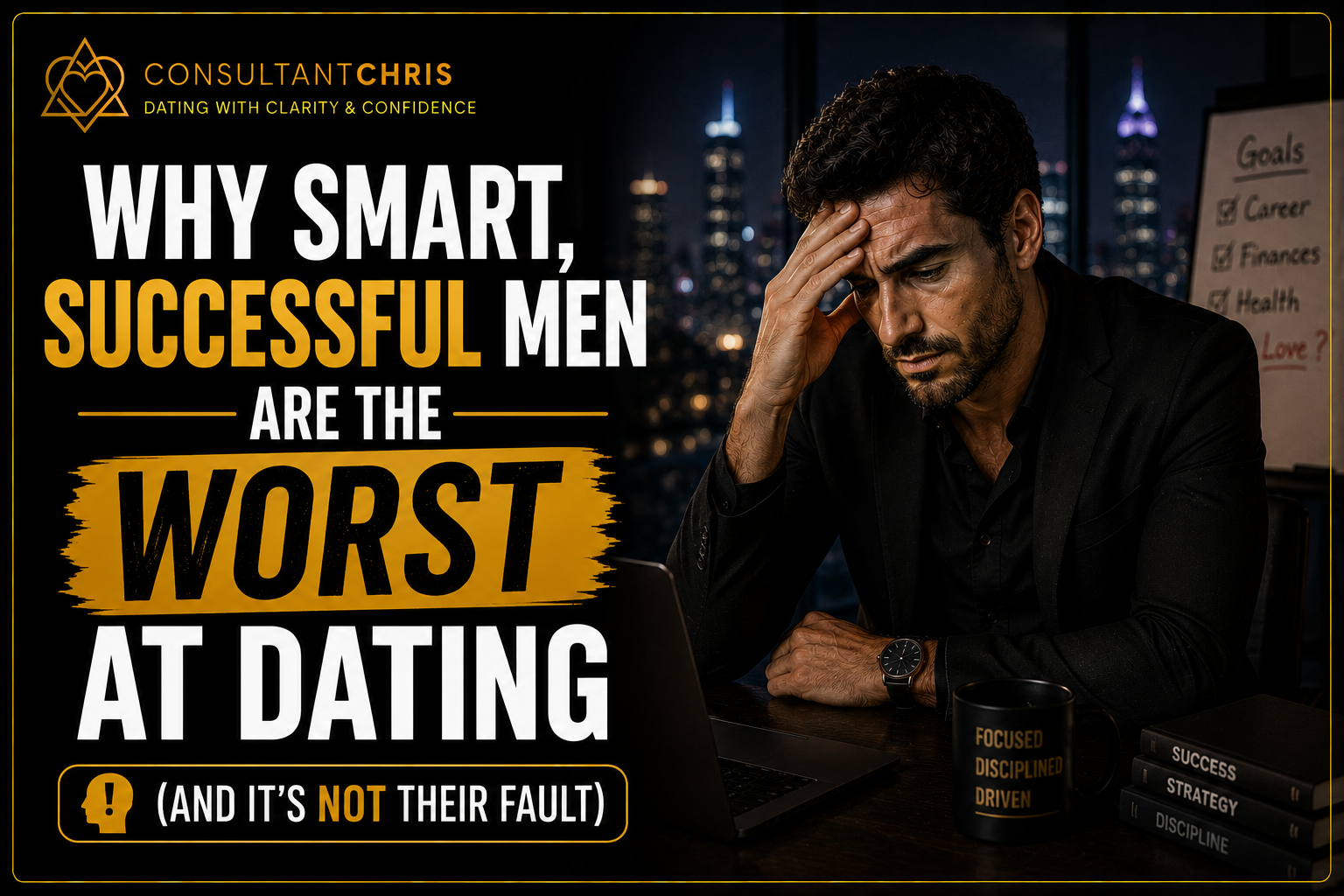
Let me paint a picture you might recognize.
You’ve built something real. A career that commands respect. A salary most people your age would kill for. A life that looks, from the outside, like it has everything figured out.
And yet, on a Friday night, you’re either scrolling through a dating app wondering why the matches aren’t converting or you’re sitting across from a woman at dinner doing everything right on paper, only to never hear from her again.
If that lands, this is for you.
Because here’s the uncomfortable truth I’ve had to tell some of the most accomplished men I’ve ever met: the very skills that made you exceptional in your career are quietly destroying your dating life. And the worst part? Nobody told you this was happening.
The System Built You to Fail at This

From the time you were a kid, you were rewarded for one thing above almost everything else: performance. Get the grades. Win the award. Hit the target. Outwork the competition. The formula was simple put in more, get more out.
It’s a fantastic formula. For work.
The problem is that relationships don’t operate on that formula. At all.
In dating, the analytical brain that helps you solve problems at 11pm, build systems, and optimize outcomes will often make you come across as cold, calculated, or disconnected even when you’re trying your hardest to connect. You’re so busy processing the interaction that you stop being present in it.
I work with men like this every single week. And the ones who struggle most are almost always the ones who’ve achieved the most. Not because success made them worse people it didn’t. But because success conditioned them to live almost entirely in their heads.
Here’s What’s Actually Going On
There’s a concept called emotional intelligence EQ for short. You’ve probably heard it mentioned in a corporate context. But in dating, EQ is everything.
EQ isn’t about being soft or oversharing your feelings on the first date. It’s about four things: knowing what you’re feeling in the moment, managing those feelings instead of being run by them, reading what the other person is feeling, and responding in a way that creates genuine connection.
Let me show you what this looks like in the real world.
Two guys. Same coffee shop. Same woman sitting alone reading a book.
Low EQ guy walks up, blurts out: ‘Oh my God, you’re gorgeous. Can I get your number?’ She gives a polite non-answer. He walks away and thinks, ‘Women just don’t like nice guys.’
High EQ guy notices she’s deeply into the book. He walks over and says: ‘That book looks intense. Are you actually into it, or are you just trying to look like the smartest person here?’ She laughs. Relaxes. Engages.
Same situation. Same goal. Completely different result. And here’s the part most men miss it wasn’t the words that were different. It was the awareness behind the words. The high EQ guy read the room first. He calibrated. He was present before he opened his mouth.
That skill emotional presence is almost never taught in school, in business, or by the people who raised most of us.
Why High Achievers Specifically Struggle

There are a few patterns I see over and over again with high-performing men.
The Performance Trap
When you’re used to executing at a high level, you bring that same energy into dating. You research. You plan the perfect date. You say the right things. But she can feel the effort, and effort reads as anxiety. It signals that the outcome matters too much to you which unconsciously communicates that you don’t quite believe you’re enough without it.
The Problem-Solving Instinct
Smart men hear a woman express frustration and immediately want to fix it. That’s not connection that’s a transaction. She didn’t come to you with a ticket to your help desk. She came wanting to feel heard and understood. Those are two entirely different things.
The Self-Awareness Deficit
Growing up being told to man up, don’t be soft, push through you learned to disconnect from your own emotions as a survival mechanism. The problem is you can’t read someone else’s emotional world if you’re shut off from your own. That’s not a character flaw. It’s a training gap.
The Good News is This Is a Skill, Not a Trait
Here’s what I genuinely love about this work. EQ is not a personality type you were either born with or you weren’t. It’s a trainable skill. The same way you built competency in your career through reps and feedback, you can build emotional competency through practice.
Research backs this up. Studies consistently show that emotional intelligence can be developed at any age. It doesn’t matter how locked down you’ve been your whole life. The pathways are there. They just need to be activated.
EQ also compounds. Looks fade. The abs you have at 32 don’t look the same at 45. But emotional intelligence? It grows. The man who invests in it at 35 becomes exponentially more attractive by 40. Not less.
Women won’t remember the perfect line you said on a date. They will absolutely remember how you made them feel. And that’s what EQ gives you the ability to make someone feel genuinely seen, heard, and at ease. That’s magnetic in a world full of men performing.
What This Looks Like in Practice

The men I work with go through a process of reconnecting with their own emotional landscape first. You can’t calibrate to someone else’s feelings if you’re emotionally flatlined yourself. From there, we work on self-regulation, learning to stay present and grounded even when nerves or overthinking kick in. Then we layer in empathy skills and real-world practice.
It’s not therapy. It’s coaching. There’s a difference. Therapy explores the why. Coaching focuses on what to do now and how to do it better next week.
The transformation I consistently see in the men who do this work is one of the most satisfying parts of my job. Not because they became slick or learned better lines. But because they finally stopped being invisible to the women they wanted to attract and started being genuinely desirable for who they actually are.
The Bottom Line
If you’re a smart, successful man struggling with dating, the problem almost certainly isn’t that you’re not enough. It’s that the same system that trained you to succeed in every other area of life left a critical skill completely unaddressed.
Emotional intelligence isn’t a soft skill. In dating, it’s the skill. And it’s learnable.
You built a career by getting better at hard things. This is a hard thing. You can get better at it.
Success at work rarely translates the way men assume it will. High earning men run into this constantly, and it often traces back to being too logical about something that isn’t.
