


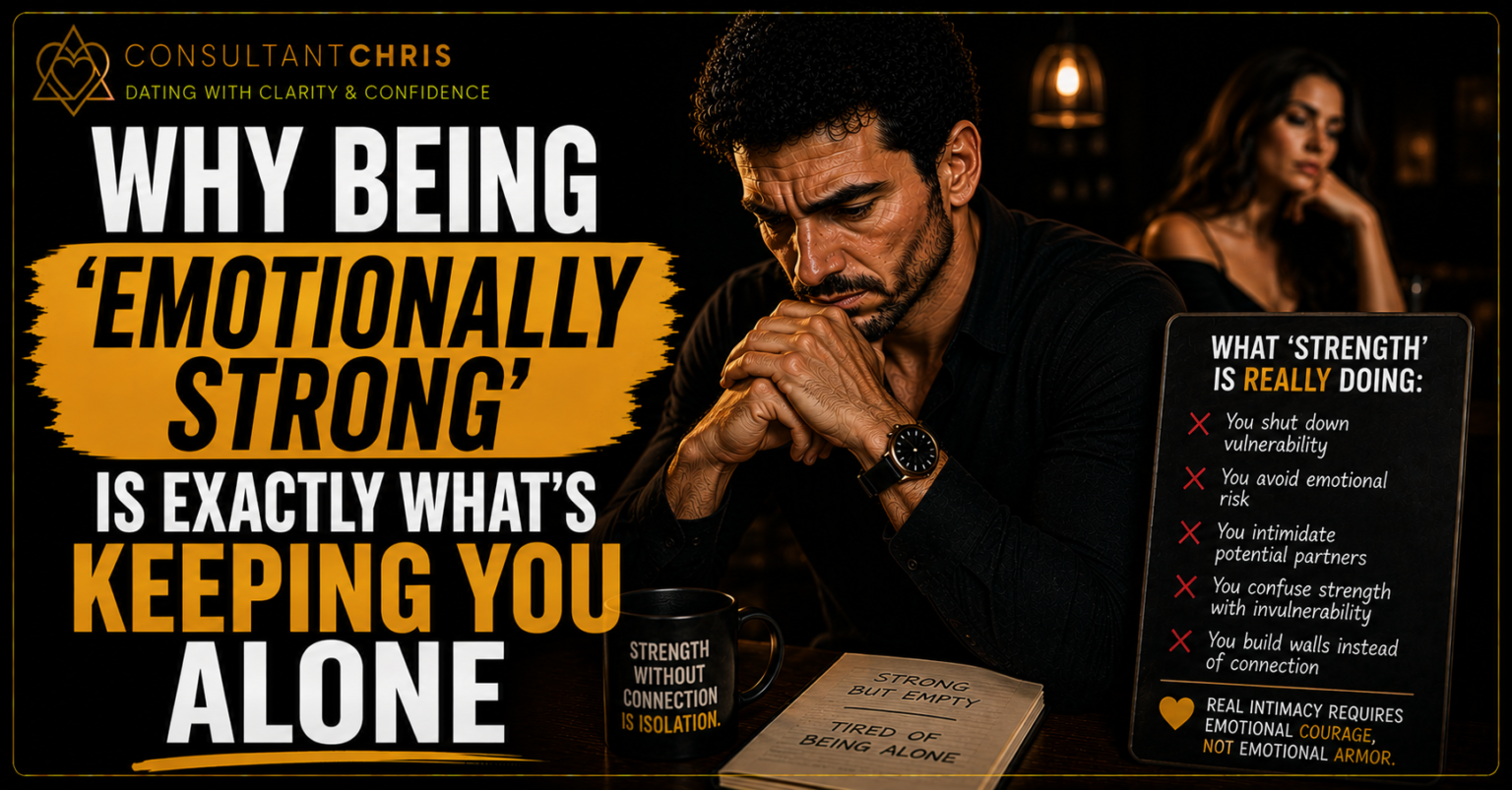
I want to start by giving credit where it’s due. For a man, having leadership skills and emotional self-control is important. The version of emotional strength most men were taught stay composed, don’t show weakness, keep it together no matter what is not entirely wrong. There is real value in being able to function under pressure, to not be destabilized by every emotional fluctuation, to show up reliably even when things are hard.
The problem is not the goal. The problem is what most men were taught the goal required.
Because somewhere along the line, “don’t be ruled by your emotions” became “don’t have emotions.” “Stay grounded under pressure” became “never let anyone know what you’re feeling.” “Be dependable” became “be a stone wall.” And a wall is very dependable, very stable, and completely unable to connect with anyone.
That fake version of strength the one that requires suppression rather than regulation isn’t strength at all. It’s armour. And while armour protects you from getting hurt, it also prevents you from getting close to people. Which means it’s protecting you from the very thing you actually want.
The Man Who Built the Wall

Let me describe someone who might be familiar.
He came up in an environment where vulnerability was a liability. Maybe his father demonstrated that real men handle things alone. Maybe expressing emotion as a kid got him mocked or dismissed. Maybe he learned early that the world doesn’t slow down for your feelings, so you learn to put them somewhere and keep moving.
He built those skills into competencies. He became reliable. Steady. The person people came to when things needed to get done. He developed a kind of low-level pride in his ability to handle things without falling apart and, to some extent, that pride is warranted. He did build something real.
But the same mechanism that keeps him functional under professional stress keeps him emotionally inaccessible in personal relationships. He doesn’t share what he’s actually going through. He deflects personal questions with humour or topic changes. He can listen to someone else’s emotional world but can’t let anyone into his own. He’s warm from a distance but rarely fully present.
Women experience this as a very specific kind of loneliness. He’s there, but he’s not reachable. And the longer a relationship goes on in that dynamic, the more exhausting it becomes for the partner who keeps trying to get through and keeps hitting the wall.
The Difference Between Suppression and Regulation
This distinction is genuinely important, so I want to be precise.
Emotional suppression is when you feel something and push it down, lock it away, refuse to acknowledge it to yourself and certainly to anyone else. It’s the ‘I’m fine’ that isn’t true. It’s the refusal to let anything show. Over time, suppression doesn’t eliminate emotion; it stores it. And stored emotion tends to leak in uncontrolled ways: irritability, emotional distance, occasional disproportionate reactions to small things, and a general flatness that people around you can feel even when they can’t name it.
Emotional regulation is something entirely different. It’s when you feel something, you know what it is, you stay with it rather than immediately shutting it down, and you choose how and when to express it rather than being run by it or bottling it.
A self-regulated man can be nervous before a difficult conversation and not let the nervousness derail the conversation. He can feel hurt by something without either suppressing it entirely or exploding. He can be moved by something without losing his groundedness.
That’s actual emotional strength. Not the absence of feeling, but the capacity to feel without being destabilized by it. And here’s what makes that kind of strength genuinely attractive: it signals safety. A woman can have an emotional moment, or bring something difficult to the table, and trust that it won’t shut you down or blow things up. You can handle it. That’s what makes a man feel like a safe person to be close to.
What Stoicism Gets Right and What It Misses
I want to give the Stoic ideal its due, because there’s something real in it. The Stoic tradition the Marcus Aurelius version, the genuine philosophical tradition, not the social-media-bro version is actually about developing the ability to respond to circumstances from a place of reason and values rather than being blown around by every emotional wind. That’s not suppression. That’s regulation. That’s genuinely useful.
But the social-media version of stoicism that a lot of men have absorbed “feel nothing, need no one, show nothing, be an island “- is not that. It’s suppression dressed up in philosophical language. And it produces men who are alone and calling it strength. They are broken inside.
Real strength is being able to feel and not be controlled by feeling. Not refusing to feel at all. The man who has never been moved by anything isn’t strong; he’s just unreachable. And unreachable men don’t build the kind of relationships worth having.
What Has to Change

The internal work here isn’t dramatic. It doesn’t require you to become someone you’re not or to start emotional processing in inappropriate contexts. It requires developing a more honest relationship with your own inner life, which is genuinely difficult if you’ve been suppressing for years, but it’s absolutely doable.
The starting point is self-awareness: learning to notice what you’re actually feeling in a given moment, name it accurately, and stop the automatic suppression reflex long enough to actually register the information your emotions are giving you. Emotions are data. They’re telling you something about what matters to you, what’s threatening you, what you want. Shutting them off doesn’t protect you from that information – it just means you’re making decisions without access to it.
The next step is calibrated expression: learning the difference between sharing your emotional experience in appropriate ways versus being overwhelmed by it in public. One of those is strength in action. The other is what suppression protects against, but it’s not the inevitable outcome of opening up. The regulation skills give you that control.
When you develop both awareness and regulation, something interesting happens. The wall comes down not because you’ve become soft, but because you no longer need it. You’re not protecting yourself from your emotions because you can handle them. And a man who can handle his emotions while staying grounded is genuinely magnetic to quality women, to strong friendships, to every relationship that matters.
The Bottom Line
Emotional strength is not emotional silence. The man who never shows anything isn’t strong – he’s defended. And a defended life is a small life.
Real strength looks like this: feeling fully, staying grounded, expressing honestly, and not needing anyone to manage your experience for you. That’s the version of strength that builds great relationships, earns real respect, and produces the kind of man who doesn’t end up alone wondering where he went wrong.
The wall kept you safe. It also kept you alone. It’s time to trade it in for something that actually serves you.
This kind of self protection tends to show up in your choices too, not just your habits. It’s often the same reason men end up attracting emotionally unavailable women, and if any of this is landing, it might explain why high standards can quietly sabotage who you let get close..
