


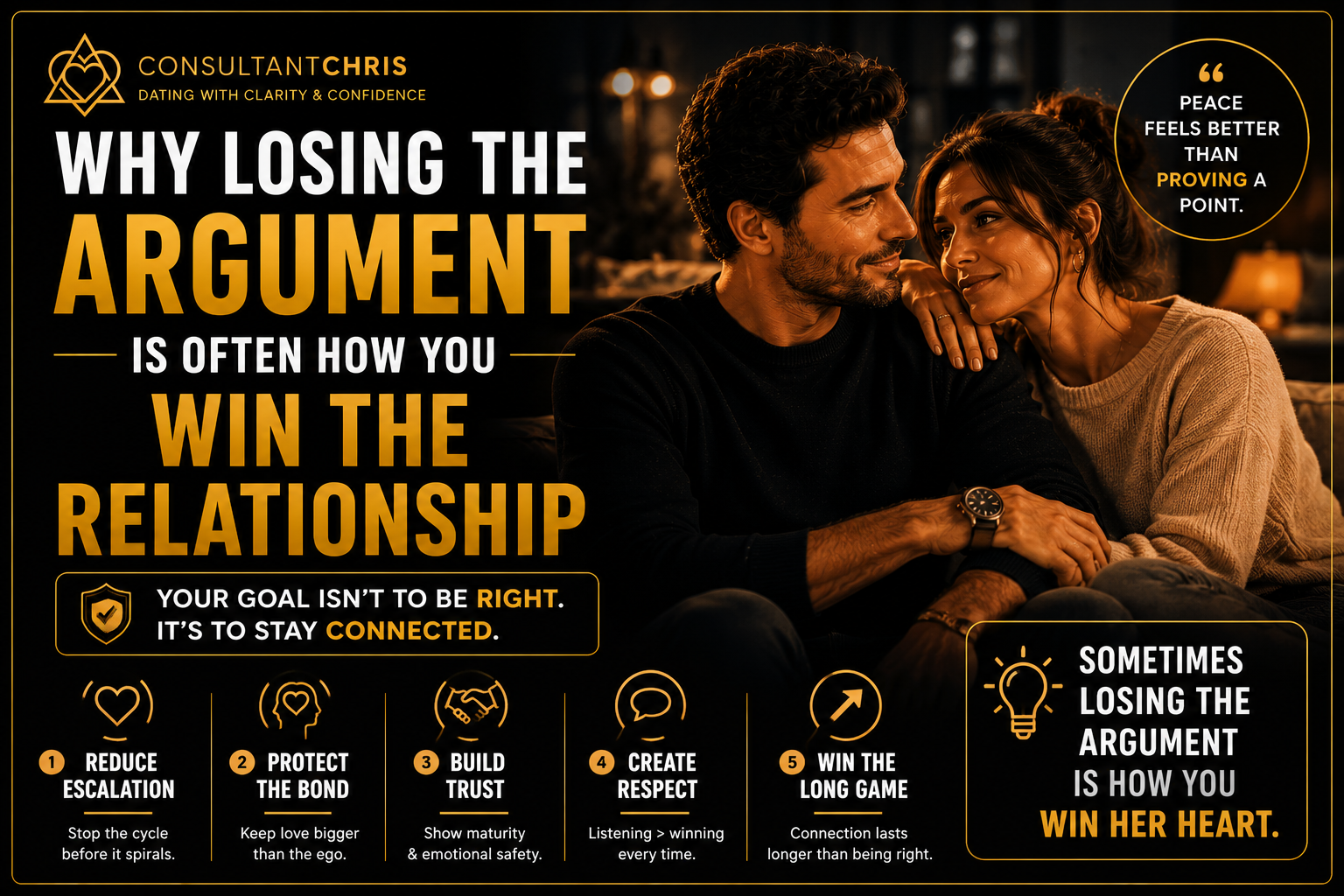
Most people enter arguments believing they are defending truth, logic, or fairness. In reality, most arguments inside relationships are not about facts at all. They are about safety, recognition, power, and belonging. This is why someone can “win” an argument logically and still lose the emotional bond that made the relationship worth having in the first place.
Sometimes the argument is not the real problem.

When Winning Breaks the Bond
I am an emotional intelligence coach and I often remind people that most arguments in relationships are not about facts. They are about feeling seen, respected, and safe.
The moment an argument turns into a debate people stop listening. Now the focus becomes who is right, who gets the last word, who backs down first. I have seen people prove their point perfectly and still weaken the relationship they wanted to protect.
When arguments become battles something subtle happens. Your partner stops bringing things up early. They begin editing themselves. Instead of reaching for connection they prepare for conflict. That is why I tell clients relationships are not strengthened by being right. They are strengthened by alignment. When two people remember they are on the same team the energy changes. The problem stops being each other and becomes something they can solve together.
Small shifts help a lot. Speaking from experience instead of accusation. Slowing down when emotions rise. Even laughing together when tension softens. These things keep the relationship larger than the argument.

We already know that couples argue frequently. Hundreds of disagreements a year is not a sign of dysfunction; it’s a sign of proximity. When two people share space, routines, stress, and expectations, friction is inevitable. The problem is not disagreement. The problem is what people are trying to get out of disagreement.
This is why experienced therapists, long-term couples, and anyone who has actually sustained intimacy over time eventually land on the same conclusion: relationships are not won by being right, they are won by being aligned. As Hunt Ethridge once put it, the goal isn’t to win every argument, but to win together as a team. That framing alone changes everything. It shifts the battlefield into a shared problem-solving space instead of a zero-sum fight.
We also know that timing, tone, and intent matter more than content. Arguments that happen late at night, when both people are exhausted, hungry, or emotionally depleted, are rarely about resolution. They are about discharge. Nothing meaningful gets solved when the nervous system is already fried. Add to that the fact that most communication is nonverbal, and suddenly the words themselves become the least important part of the exchange. Eye-rolling, sighing, posture, sarcasm, and dismissiveness do more damage than any poorly chosen sentence.
We know, too, that accusations escalate conflict while ownership de-escalates it. “You always” and “you never” are invitations to war. “I feel” is an invitation to understanding. Not because it’s polite, but because it gives your partner something they can respond to without having to defend their entire character. The shift from blame to experience is one of the simplest and most powerful tools couples have, and yet it’s constantly ignored in favor of proving a point.
We even know that humor, when used gently and not as mockery, can defuse tension and remind both people that they are on the same side. Laughing together doesn’t trivialize the issue; it humanizes it. It reminds both partners that the relationship is bigger than the disagreement.
All of this is well-documented, well-understood, and widely agreed upon. And yet people still argue as if the objective is conquest. Which brings us to the real problem.
When Losing Yourself Is the Real Problem
But there is another side to this conversation. Losing the argument is not always healthy.
Some people hear “choose the relationship” and interpret it as “always surrender”. They apologize just to end the tension. They accept blame that is not theirs. Over time this does not create peace. It creates quiet resentment.
I have worked with many people who slowly disappeared inside their relationships. Their voices became smaller while their needs became negotiable. What looked like patience was actually self erasure.
A relationship where one person is always wrong and the other always right stops feeling like a partnership. It becomes a hierarchy. And hierarchy inside intimacy eventually erodes respect. There is a big difference between accountability and manipulation. Accountability sounds like I made a mistake and I want to understand how it affected you. Manipulation sounds like everything is your fault and you must fix what I feel.
Losing the argument only helps when the disagreement is about ego or small preferences. Maybe you interrupted without noticing. Maybe something small matters more to your partner than it does to you. In those moments saying you are right can build trust.
But when responsibility only moves in one direction the problem is no longer the argument. The problem is the relationship itself.

When It Is Healthy to Say: “You’re Right. How Can WE Make This Better?”
The first healthy scenario is when your partner is pointing out a real behavior that affects the relationship, and you can see it clearly once the defensiveness drops. For example, maybe you genuinely interrupt them during conversations or dismiss concerns because you think they’re minor. In the moment, your instinct may be to argue intent. But intent doesn’t erase impact. Saying “you’re right, I didn’t realize how that landed, how can we adjust this together?” doesn’t make you weaker. It makes you trustworthy. It signals that growth matters more than ego.
The second scenario is when the conflict is about preferences, not principles. Things like routines, habits, or logistical annoyances often turn into power struggles when they don’t need to be. Maybe your partner needs more reassurance, more planning, or more structure than you naturally operate with. That doesn’t make them wrong. It makes them different. Saying “you’re right that this matters to you, how can we build something that works for both of us?” reframes the entire issue as a shared design challenge rather than a flaw hunt.
In both cases, the key phrase is not “you’re right.” It’s “how can we.” The moment the language becomes collaborative, the nervous system relaxes. The argument stops being about who failed and starts being about how to improve the system you’re both living inside.
When It Is Time to Cut Your Losses and End the Relationship
The first clear exit scenario is when taking responsibility is demanded but never reciprocated. If every conflict ends with you apologizing, adjusting, and reflecting while your partner never owns their part, you are not in a relationship, you are in a tribunal. Over time, this dynamic will hollow you out. You will lose your voice, then your confidence, then your sense of self. Ending the relationship at that point is not quitting. It is self-preservation.
The second scenario is when conflict includes abuse, manipulation, or coercion. If arguments involve intimidation, threats, humiliation, gaslighting, or pressure to abandon your boundaries just to keep the peace, there is nothing to “win.” Staying longer does not prove loyalty or strength. It only teaches the other person that harm has no consequences. Leaving before you lose yourself, their respect, and the relationship anyway is the only move that actually preserves your dignity.
In both cases, the relationship is not being destroyed by disagreement. It is being destroyed by refusal to engage in mutual responsibility. And no amount of calm communication techniques can fix that.
Conclusion
Healthy conflict is not about silence or domination. It is about orientation. Are you trying to defeat each other or understand each other? Are you protecting your ego or protecting the bond between you.
The couples who last are not the ones who avoid disagreement. They are the ones who remember they are on the same team. They pause when emotions rise. They listen before reacting. They ask; how can we solve this? instead of how can I prove my point?
Sometimes losing the argument does win the relationship. But only when what you are losing is ego, not yourself.
Knowing when to let go of being right is its own skill. Difficult conversations go a lot smoother once you learn this, and a good apology can repair more damage than winning ever could.
