


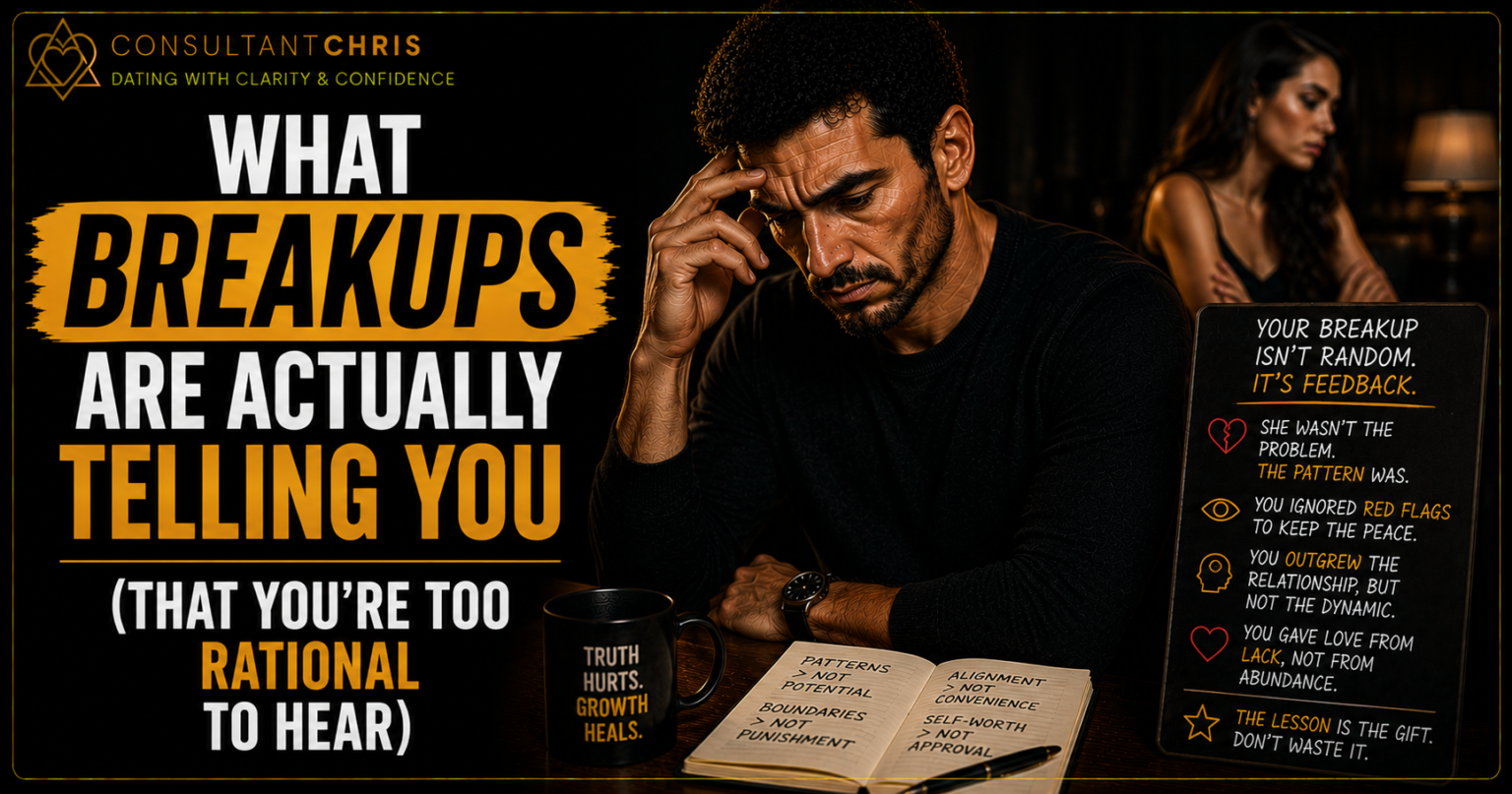
Here’s what most men do after a breakup.

They get through the initial pain, the replaying of memories, the late-night texts they may or may not send. And then, as quickly as possible, they move forward. They get busy. They hit the gym harder. They throw themselves into work. They rationalize what happened, construct a narrative that closes the chapter cleanly, and decide they’re ready to move on.
This is understandable. It’s also, in a very specific way, a waste of one of the most valuable learning opportunities that life provides.
I’m not suggesting that men should wallow in breakups or spend years processing a relationship that didn’t work out. I’m suggesting something more precise: that the pattern of what happened in your last significant relationship, if you’re willing to look at it honestly, contains more useful information about your emotional life than almost anything else you could examine. And most men never look. Because looking requires sitting with something uncomfortable, and the rational mind would much rather move on.
Most men tend to have the same relationships over and over again with different people. If you have not fixed your inner patterns. You are just going to do the same thing over and over again.
Why Breakups Are Actually Data
A breakup is, among other things, the result of two emotional systems interacting over time in ways that ultimately proved incompatible or unsustainable. The specific ways it broke down the arguments that kept repeating, the needs that kept going unmet, the distance that developed, the moment the feeling changed these are not random. They follow patterns.
Those patterns almost always trace back to something identifiable: an attachment style that creates predictable dynamics in relationships, an emotional skill gap that shows up under stress, a recurring blindspot about what you actually need or what you’re actually offering, a defense mechanism that protected you in the short term and cost you in the long term.
If you never examine the pattern, you take it with you. Unexamined into the next relationship, where it produces the same outcome, possibly on a different timeline with a different person. This is not bad luck. It’s unaddressed data.
The Specific Things Worth Looking At
The Arguments You Had Over and Over
Recurring arguments in relationships are almost never about the surface content the dishes, the schedule, the tone of a text. They’re about underlying needs and fears that aren’t being addressed directly. What were your recurring arguments actually about, stripped of the specific triggering event? What need was she expressing? What need were you protecting? What emotion underneath the argument were neither of you actually naming?
The Moments You Emotionally Withdrew
For most high-achieving men, there’s a pattern of emotional withdrawal under pressure that the other person experiences as abandonment, even when that’s not the intent. Think about when you went quiet, got busy, became logistical rather than emotional. What was happening inside you in those situations? What were you managing or protecting against? This is often where the most important information lives.
The Needs You Didn’t Voice
Most men in relationships have needs they never articulate for space, for appreciation, for certain kinds of connection, and then gradually build resentment when those needs go unmet, even though the other person had no idea they existed. What did you need in your last relationship that you never actually asked for? And what did that silence cost both of you?
The Moment the Connection Changed
There’s almost always a moment, or a period, when the emotional tone of a relationship changes when something that had been open starts to close. Can you identify when that happened? What preceded it? What changed in how you were showing up, or how she was, or both? That inflection point usually contains the most concentrated information about what the relationship actually needed that it wasn’t getting.
Why Analytical Men Are Particularly Bad at This

The irony is rich and worth naming directly: the men who are best equipped to analyse complex systems are often the worst at analysing the emotional system of their own relationships.
Because the analytical brain, when turned toward emotionally charged material, tends to do one of two things: it either intellectualises, constructing abstract frameworks about what happened that feel like understanding but carefully avoid genuine feeling, or it dismisses, deciding that the emotional dimension isn’t worth the processing time and moving on to something more tractable.
Neither of those is actually processing the breakup. Both of them are avoiding it. And the avoidance is understandable; genuine emotional processing is uncomfortable, it doesn’t produce neat conclusions, and it requires sitting with uncertainty. But the discomfort is the point. That’s where the information is.
What Processing Actually Looks Like
I want to be concrete about this, because “process your emotions” is advice that sounds right and gives almost no guidance about how.
It starts with writing. Not composing writing. Specifically, writing about what you actually felt at different points in the relationship and the breakup, without editing or judging. Not what you think about what happened. What you felt. There is a significant difference, and for most men it takes active effort to access the feeling layer rather than defaulting to the thinking layer.
Then it involves sitting with the patterns that emerge without immediately trying to resolve them. You notice: I consistently withdrew when she brought up the future. I don’t need to fix that right now. I just need to know that it’s true.
And eventually it involves asking the question that most men resist: what did this relationship reveal about me that I need to develop? Not what was wrong with her, not what circumstances were unfair what does my participation in this dynamic tell me about where I still have work to do?
That question, honestly answered, is worth more than a thousand hours of self-improvement content. Because it’s specific. It’s yours. And it points directly at the thing that will produce a different result next time if you address it.
What’s on the Other Side

Men who do this work who actually sit with their breakups rather than rushing past them come out the other side with something genuinely valuable: a level of self-knowledge that is rare, and that directly translates into better relationships going forward.
Not because they’ve healed or resolved everything, but because they know more specifically what they’re working with. What their patterns are. Where their emotional skill gaps live. What they actually need from a partner, as opposed to what they thought they needed.
If you’re trying to make sense of a pattern rather than a single ending, it helps to zoom out first. Understanding why long term relationships end lays out the bigger picture, and it might come down to who you’re attracting in the first place.
The breakup, viewed this way, isn’t just an ending. It’s an extremely well-funded piece of research into your own emotional life. Most men throw the data away. The ones who use it come out on the other side considerably further ahead.
