


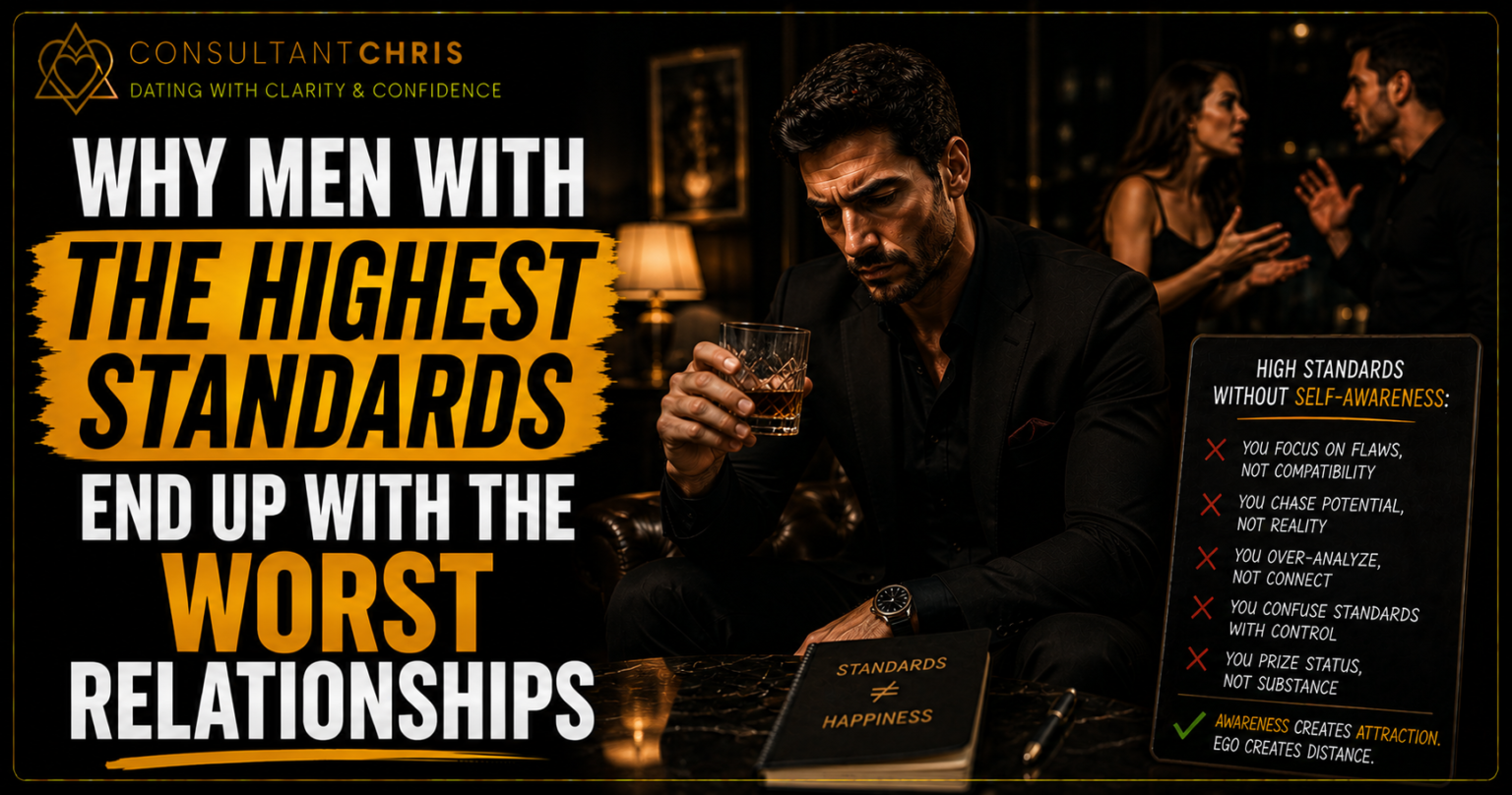
Let me describe two men, both of whom will tell you they have high standards.

The first man has spent years building a clear picture of what he wants in a partner. She needs to be intellectually sharp. He wants genuine warmth and emotional depth, someone who can hold a real conversation and who is genuinely kind to the people around her. He wants alignment on values how they approach health, how they think about family, what they want their life to look like. These things matter to him, and he’s willing to pass on connections that don’t have them.
The second man also says he has high standards. But what he’s actually carrying is a checklist that he applies to every woman he meets like a job application. She needs to be a specific kind of attractive, have a specific career trajectory, enjoy specific activities, display a specific kind of personality within the first few interactions. Any deviation from the expected profile gets mentally filed as a disqualifier. He goes on a lot of first dates. He rarely makes it past three.
Both men use the same language. They are describing fundamentally different things. And the second man the checklist man will often end up in the worst relational outcomes of anyone, precisely because of the mechanism he believes is protecting him.
The Difference Between Standards and Checklists
This distinction is genuinely important and I want to draw it clearly.
Real standards are about values, character, and the quality of how someone shows up in the world. They’re things like: does this person have genuine kindness? Are they honest, even when it costs them something? Do their actions match their words over time? Do I feel like myself around them not just comfortable, but actually myself? These standards are worth holding firmly, because they predict whether a relationship will actually be good rather than just impressive-looking.
Checklists are about attributes. External, often surface-level characteristics that feel like standards but are actually proxies – rough guesses at what might correlate with a good partner, based on a mental model that may or may not reflect reality. She needs to be in a particular profession. She can’t have been married before. She needs to be a specific kind of physically attractive in a specific way. She needs to have particular hobbies.
Some of these things matter. Most of them matter a lot less than the men who hold them believe. And the problem isn’t that having preferences is wrong; it’s that a rigid, extensive checklist functions as a wall, not a filter. It keeps out a lot of genuinely compatible people because they didn’t match the proxy measures, while doing almost nothing to protect you from someone who scores well on the checklist but has none of the underlying character that actually makes a relationship work.
Why High Achievers Are Especially Prone to This

The analytical mind that makes high-performing men excellent at their work is also what produces the checklist problem. They are, professionally, people who identify criteria, screen against them, and select the option that scores highest. That process is valuable when you’re hiring, making investments, or solving structured problems.
Applied to human beings, it misses everything that matters most.
Connection is not a scoring exercise. The quality that makes someone a genuinely good partner – the way they handle conflict, how they show up on the difficult days, whether they make you feel known rather than just appreciated none of that is visible in the first three dates, and almost none of it is captured by any checklist.
The high-achieving man who applies rigorous screening criteria to dating is optimising for the wrong variables, with the precision and confidence of someone who has solved a lot of hard problems and doesn’t quite grasp that this one doesn’t yield to the same approach.
The Deeper Issue Underneath the Checklist
Here’s what I’ve noticed in the men I work with who carry rigid, extensive checklists: the checklist is almost never really about finding the right person. It’s about managing the fear of making the wrong choice.
When you’ve built something significant – a career, a reputation, a life you’re proud of – the idea of investing deeply in a relationship and having it not work out is genuinely threatening. The checklist feels like due diligence. Like you’re being appropriately careful with something important. Like you’re protecting yourself from a costly mistake.
What it’s actually doing is keeping you at a safe remove from genuine risk. Because genuine connection requires genuine openness, which means genuine vulnerability, which means the possibility of genuine disappointment. The checklist, by ensuring that no one ever gets through all the filters and into real consideration, protects against that possibility. At the cost of the thing it’s supposedly helping you find.
What Real Standards in Practice Look Like
Real standards don’t make you harder to be with. They make you easier to be with for the right people, because they’re communicated with confidence and lived with consistency.
Chris teaches something I think is exactly right on this: standards are best communicated not as rules or disqualifiers, but as expressions of how you live. Not ‘I don’t date women who don’t prioritise their health’ but ‘I’m really focused on my own health and growth right now, so I naturally connect best with people who are moving in a similar direction.’ One version closes a door with judgment. The other opens a door with an invitation. The underlying standard is identical. The relational effect is completely different.
And the non-negotiables the ones worth actually holding firm on tend to be a short list. Honesty. Genuine kindness. Emotional availability. Alignment on the things that genuinely shape a life. Everything else is a preference, and preferences can flex.
High standards and self protection often come from the same place, which is worth sitting with. It ties closely into being emotionally strong, and it can quietly steer you toward emotionally unavailable women instead.
The Relationship You’re Actually Looking For

The men who end up in the best long-term relationships are almost never the men who were the most rigorous screeners. They’re the men who were genuinely open, who gave connections that didn’t perfectly match the profile a real chance while holding firm on the things that actually matter at depth.
They also did something else: they worked on themselves with the same energy they applied to evaluating other people. Because the dynamic of a relationship is co-created. The quality of what you attract reflects the quality of what you bring. A man who has done serious work on his emotional intelligence, his self-awareness, his ability to create genuine connection that man doesn’t need a forty-point checklist, because he knows what he’s looking for and he can feel when it’s there.
Standards matter. But the standard worth holding most firmly is the one you apply to yourself.
