



I’m going to say something you probably didn’t expect to read on a dating coach’s blog.
A significant portion of the dating coaching industry is not good. Some of it is actively harmful. And if you’ve done any research into this space and walked away skeptical, I think that skepticism is largely earned.
I’m saying this because I think the men who need real help most are also the ones most likely to dismiss the idea of coaching entirely because the public face of this industry has given them legitimate reasons to be wary. And they end up staying stuck because they can’t distinguish between what’s real and what’s a scam.
So let me make that distinction as clearly as I can. Because real coaching the kind built on actual psychology, genuine skill development, and honest accountability does produce results. It’s just not the majority of what gets marketed under that label.
What the Bad Version Looks Like
The dating coaching industry has a supply problem. Because there are no licensing requirements, no standardised training, and a very low barrier to calling yourself a coach, a large number of people have entered this space with credentials that amount to ‘I used to struggle with dating and now I don’t.’
That personal transformation is real and meaningful. What it doesn’t automatically produce is the ability to help other people transform which requires a completely different skill set than having gone through a personal process.
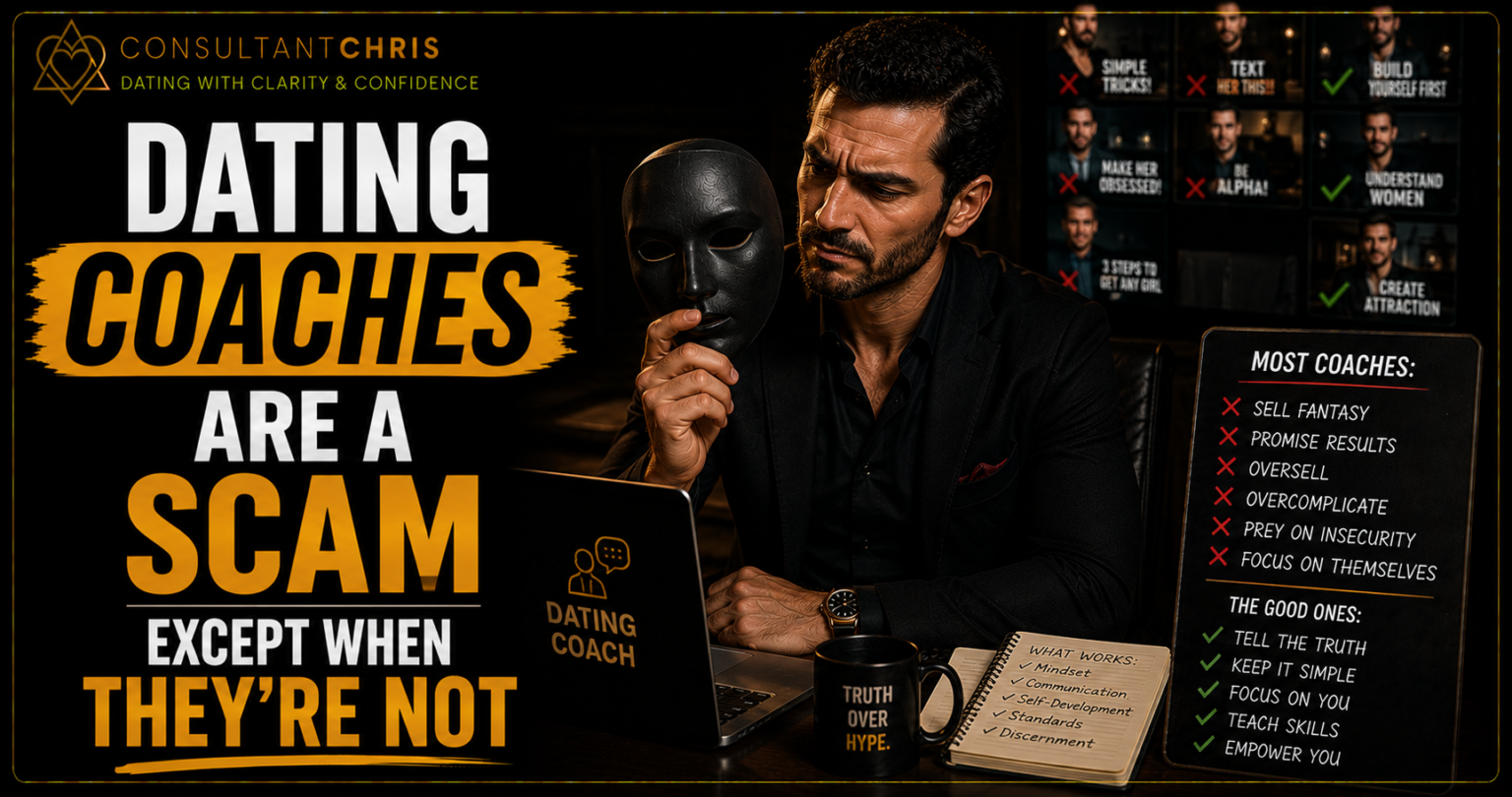
The bad version of dating coaching tends to share certain characteristics. It’s built primarily on tactics and scripts rather than genuine skill development. It frames women as targets or problems to be solved rather than people to connect with. It promises specific results a certain number of dates, a guaranteed outcome which any honest practitioner knows is not how human dynamics work. It creates dependency rather than capability, keeping you in the coaching funnel rather than building the internal resources to not need it.
You can usually identify it quickly. If the marketing leads with lines, hacks, or psychological tricks — that’s the bad version. If it promises a specific number of dates or guarantees attraction — that’s the bad version. If the primary transformation being sold is about how you perform rather than who you actually are — that’s the bad version.
What Good Coaching Is Actually Built On

Real coaching in this domain is grounded in established psychology attachment theory, emotional intelligence research, the genuine science of how attraction and connection develop. It treats the client as a whole person with a specific history, specific patterns, and specific skill gaps not as a blank slate to be loaded with techniques.
It focuses on developing genuine capabilities rather than surface behaviours. The difference between ‘here’s a line to use in this situation’ and ‘here’s how to develop the self-awareness to read what’s actually needed in any situation and respond from a genuinely grounded place.’ One produces a robot with better scripts. The other produces a man who is actually more capable in every interaction.
It’s honest about what coaching can and can’t do. It can help you develop real skills. It can help you identify and shift patterns that have been keeping you stuck. It can provide accountability and structured feedback that accelerates development far beyond what you’d achieve alone. It cannot guarantee specific outcomes, because human beings are not systems with deterministic outputs. Anyone who tells you otherwise is selling you something.
And crucially good coaching is working toward its own obsolescence. The goal is a client who no longer needs the coach because he has the internal resources to navigate his own life. Not a client who stays dependent on a framework that only works when someone is managing it for him.
The Specific Question Worth Asking
If you’re evaluating any coaching programme including mine the most useful question you can ask is: what specifically will I be able to do at the end of this that I can’t do now?
If the answer is vague (‘you’ll be more confident,’ ‘women will respond differently’) that’s a concern. Confidence and improved responses are outcomes, not skills. What are the specific, trainable skills being developed that will produce those outcomes?
In the programme I run, the answer is specific: you will develop measurable emotional self-awareness, the ability to regulate your emotional responses under social pressure, a genuine empathy capacity that improves your ability to read and respond to other people, and improved social skills grounded in those foundations. Those are real, trainable skills with identifiable markers. You can assess whether you’re developing them. They transfer beyond dating into every relationship in your life.
That’s what the good version looks like. It has a clear mechanism of change, not just a promised outcome.
Why the Skeptics Are Right to Be Skeptical and Wrong to Dismiss Entirely

The men who are most skeptical of coaching are often the most analytical which is also the population most likely to benefit significantly from this specific kind of work, because the emotional intelligence gap is most pronounced in men who have developed the analytical side of their intelligence at the expense of the emotional side.
Their skepticism makes sense in context. They’ve been burned by vague promises before. They’ve consumed content that didn’t produce results. They’ve watched enough of the industry to have a legitimate read on how much of it is nonsense.
But dismissing the entire category because large parts of it are bad is the same logical error as dismissing all financial advisors because many of them underperform passive index funds. Some advisors genuinely add value. The question is knowing what to look for.
What to look for in a dating coach: grounding in real psychology, not internet-bro philosophy. A framework focused on your development, not their techniques. Honest acknowledgment of what coaching can and can’t guarantee. Evidence of genuine client results not testimonials about confidence, but specific descriptions of what actually changed and how.
The real thing exists. It produces real results. It’s worth finding and worth distinguishing from the noise around it.
Knowing what to look for makes all the difference. One honest account of hiring a coach lays out both sides, and it’s worth comparing against what the pickup artist industry got wrong.
