


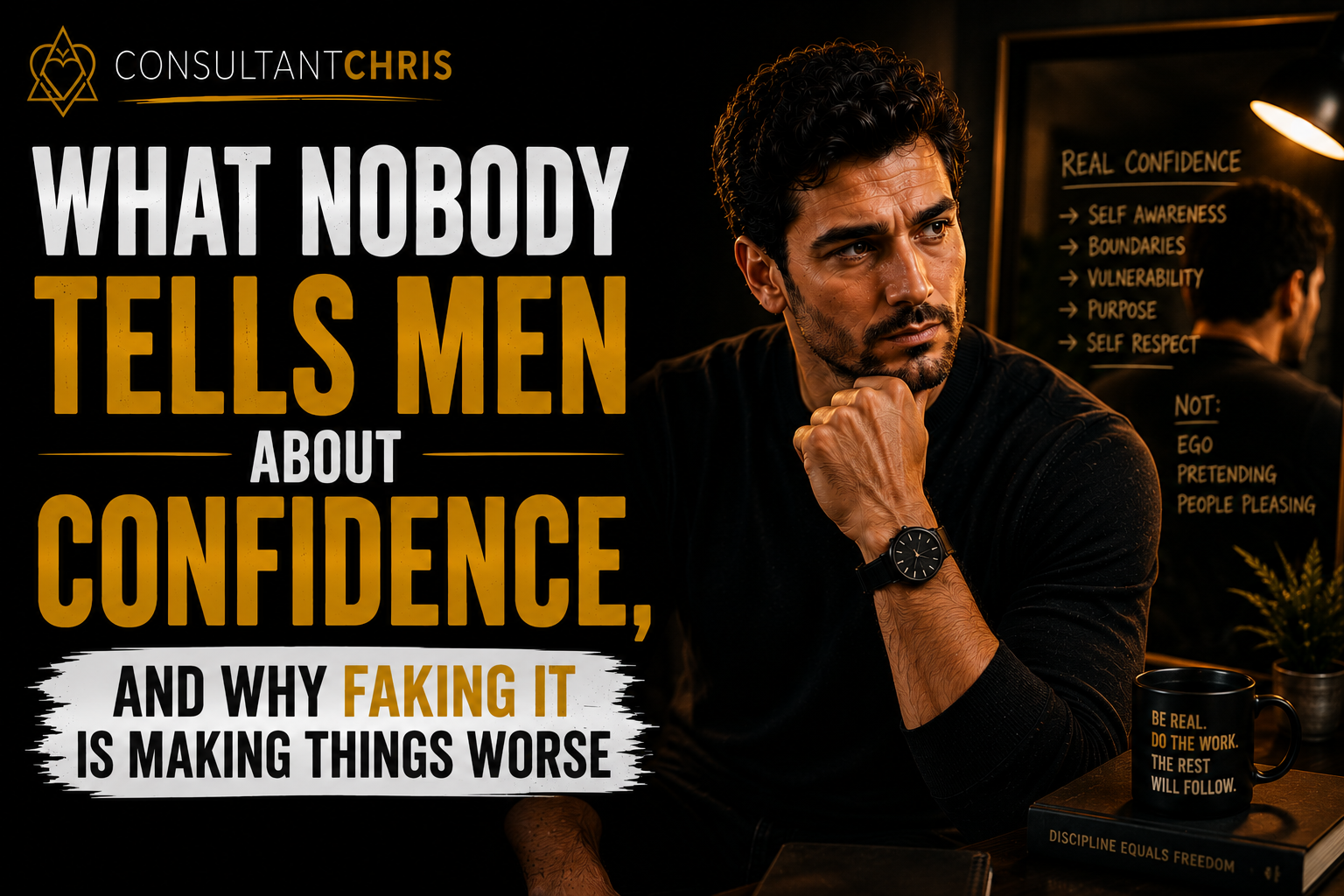
There is a piece of advice that has been handed to men with such consistency and such confidence that it has become almost unquestioned.
Fake it till you make it.
Act confident even when you are not. Stand tall, speak louder, take up more space, project certainty and eventually the feeling will follow the behaviour. It sounds reasonable. It has been repeated by coaches, mentors, motivational speakers, and well-meaning friends for decades.
And for a lot of men in a lot of situations, it is making things actively worse.
I want to explain why precisely, not just contrarily and then give you a framework for what real confidence actually is, where it comes from, and how to develop it in a way that does not collapse the moment someone looks at you with genuine curiosity.
Why Performed Confidence Fails Specifically in Dating

In professional contexts, a performance of confidence can carry you long enough for actual competence to fill the gap. You walk into a meeting projecting certainty, and by the time anyone has reason to question it, you have delivered results that make the question irrelevant. The environment rewards the performance.
Dating does not work this way. Women are extraordinarily attuned to the gap between performed and genuine states — not through any mystical ability, but because evolution has given human beings highly calibrated detectors for social incongruence. A performed confidence that does not match the underlying internal state creates exactly the kind of incongruence that registers as something off, even when the observer cannot name what specifically triggered the response.
The man performing confidence is doing something else simultaneously: he is managing his presentation rather than being in the interaction. And that management takes him out of presence — out of the actual moment, the actual person, the actual conversation in ways that are palpable to anyone paying attention. He is there. He is also, somehow, not quite there.
The performed confidence also tends to collapse under mild pressure. She challenges a statement. She asks something unexpected. She is less warm than anticipated. And the house of performed certainty, built on no genuine foundation, visibly shifts. She notices. And what she notices is not just a man who was wrong about something. She notices a man who was not real.
What Confidence Actually Is

Real confidence is not a feeling. This is the thing nobody tells men, and it changes everything once you understand it.
Real confidence is a relationship with uncertainty. It is the internal knowledge built through experience, not through affirmation that you can handle whatever happens. Not that things will always go well. Not that you will never feel anxious or uncertain. But that when things do not go well, when you do feel anxious, when something unexpected happens, you will be okay. You have handled difficulty before and you will handle it again.
That relationship with uncertainty is not something you can perform. It is something you accumulate through genuine experience of doing hard things, handling the outcomes including the uncomfortable ones — and discovering that you are more capable than your anxiety predicted.
In dating specifically: real confidence is the man who approaches a woman knowing she might not be interested, and who can handle that outcome without it meaning anything terrible about him. The man who expresses genuine interest knowing it might not be reciprocated, and who can sit with that without collapsing. The man who has an opinion that differs from hers and can hold it without becoming defensive or immediately abandoning it for approval.
None of that requires performing anything. It requires a genuine internal foundation that most men have never deliberately built.
Where Real Confidence Actually Comes From
Accumulated Evidence of Competence
Real confidence is built through doing, not through telling yourself you are confident. Every time you approach a situation that feels risky and handle it regardless of the outcome you add a data point to your internal record of evidence. Over time, that record builds a genuine foundation: I have been in hard situations and I have handled them. That is not a performance. It is a fact.
Self-Knowledge
The man who knows who he is his actual values, his genuine interests, what he cares about, what he will and will not accept does not need external validation to feel grounded. He already knows who he is, so other people’s assessments of him are interesting data rather than existential verdicts. That self-knowledge is the internal anchor that performed confidence is trying to simulate.
Regulation Under Pressure
The ability to manage your emotional state in high-stakes moments to stay grounded when something does not go the way you expected is what genuine confidence looks like in action. It is not the absence of nerves. It is the ability to feel the nerves without being run by them. This is a trainable skill, specifically the self-regulation pillar of emotional intelligence, and it is what separates the man who seems confident from the man who actually is.
The Practical Path

Stop trying to feel confident before you act. Start acting in ways that are consistent with your values and your genuine interest, and let the confidence build from the evidence that accumulates.
This is not fake it till you make it. It is do the thing from a real place and let reality give you the foundation that no amount of affirmation can provide. The approach that does not go perfectly but you handled with grace. The direct conversation you had even though it was uncomfortable. The opinion you held even when it was not popular. Each one of those is a real data point. Stack enough of them and you do not need to perform anything.
You become the man who is actually confident. And she can feel the difference.
Real confidence and performed confidence read completely differently to other people. Charisma works the same way, and this connects to why so many men are still waiting to feel ready before they even try.
