


I want to start with something uncomfortable.
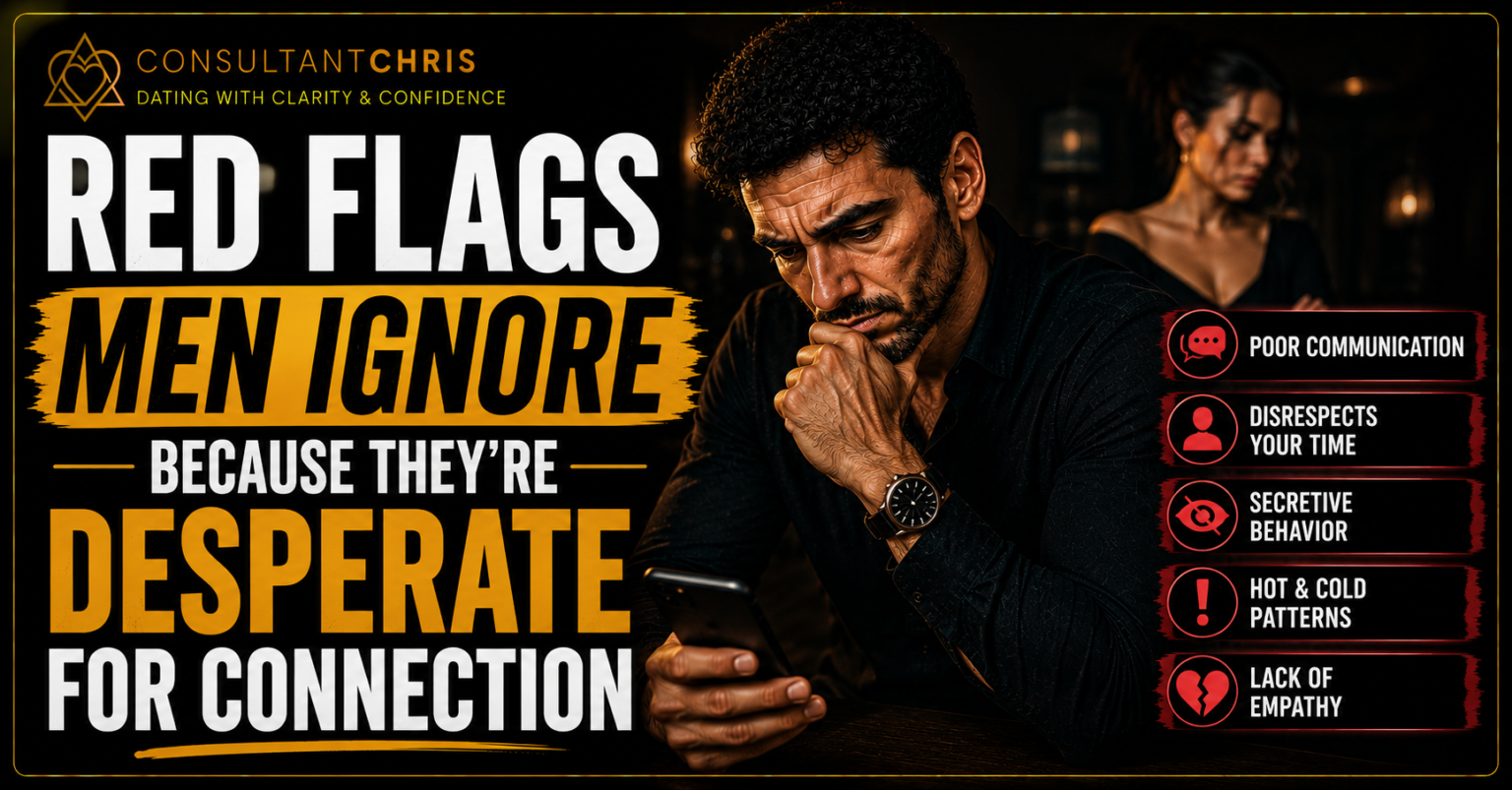
Most men don’t ignore red flags because they’re stupid. They ignore them because connection feels so rare and so good when it shows up that the brain does something very specific it suppresses the information that threatens to take the connection away.
This is not a character flaw. It’s neurochemistry. But understanding why it happens is the first step to not letting it run your dating life into walls you saw coming from miles away.
I’ve worked with extraordinarily intelligent men who looked back at relationships that cost them years of their lives, significant emotional damage, and in some cases real financial and professional disruption and when they’re honest about it, the signs were there early. Not hidden. Not subtle. There. And they found ways to explain them away, minimize them, or simply not register them because the pull of connection was stronger than the signal of warning.
Let’s talk about why this happens and what to do about it.
The Connection Hunger That Makes You Vulnerable

For many professional men, genuine emotional connection is genuinely rare in their lives. Not because they’re unlovable because the environments they operate in don’t reward emotional openness. Work relationships are transactional. Friendships, for a lot of men past 35, are surface-level and infrequent. Family dynamics often carry their own complexity.
So when a woman shows up who makes you feel genuinely seen, who creates real warmth, who seems to actually understand you the relief of that is enormous. And the brain, in the presence of that relief, does not want to introduce information that would destabilize it. So it filters. Minimizes. Rationalizes. Finds reasons why the thing that seemed like a concern isn’t really a concern.
This is the mechanism. And the more lonely or connection-starved you’ve been, the stronger the mechanism runs.
The Red Flags That Are Easiest to Ignore
Inconsistency Between Words and Actions
She says she’s interested but is consistently unavailable. She talks about wanting something serious but behaves in ways that create constant uncertainty. The words are what you want to hear. The actions are telling you something different. Most men, when they’re emotionally invested, choose to believe the words. The actions are the data.
Disrespect That Gets Minimized as Humor or Honesty
Small put-downs framed as jokes. Dismissiveness about your feelings disguised as being ‘real.’ Boundary violations reframed as passion or spontaneity. When someone is occasionally unkind to you in ways that are easy to explain away, and you consistently choose to explain them away rather than address them, that’s a pattern worth examining.
The Way She Treats Other People
How she talks about her exes. How she treats service staff. How she behaves when things don’t go her way in low-stakes situations. These are not irrelevant details. They’re windows into character that are much easier to see clearly before you’re deeply emotionally invested. After, they’re much harder to look at honestly.
Your Own Body’s Response
This one is the most underrated. When you’re around her, do you feel relaxed and genuinely yourself, or do you feel slightly on edge, constantly monitoring, performing, slightly anxious about what comes next? Chronic low-grade anxiety in someone’s presence is information. It’s not chemistry. It’s your nervous system trying to tell you something.
Why Smart Men Are Especially Vulnerable

There’s a specific vulnerability that intelligent, analytical men have in this area that isn’t obvious at first.
Smart men are very good at constructing arguments. Which means that when the emotional brain has already decided it wants something, the analytical brain gets recruited to justify that decision rather than evaluate it clearly. You become your own best defense attorney for a case you should be looking at more honestly.
You’ll find the nuanced explanation for why the red flag isn’t really a red flag in this case. You’ll construct a theory about why her behavior makes sense given her history. You’ll identify the unique combination of factors that means the normal rules don’t apply here. All of it very sophisticated. None of it serving you.
Intelligence does not protect you from emotional blind spots. In some cases, it makes them harder to correct because you’re better equipped to defend them.
The Role of Emotional Intelligence in Actually Seeing Clearly

The reason I talk about EQ in the context of red flags is that most of what makes you miss them is an emotional regulation failure, not an intelligence failure.
When the fear of losing connection is running at a high enough level, your capacity for clear observation drops dramatically. You’re not in a state where you can evaluate what you’re seeing — you’re in a state where you’re managing the anxiety of potential loss. Those are different mental operating modes, and only one of them can think clearly.
Building emotional self-regulation the ability to notice your own emotional state, name it, and prevent it from hijacking your perception is what allows you to see people clearly even when you’re attracted to them. Not coldly. Not defensively. Clearly. With both the warmth of genuine interest and the groundedness to register what’s actually in front of you.
This doesn’t mean becoming suspicious of everyone or looking for problems. It means developing the internal stability to hold both things at once: genuine openness to connection and honest perception of what the connection is actually built on.
A Practical Approach
There’s a simple practice I give clients that’s worth sharing here. In the first few weeks of seeing someone new, after each interaction, ask yourself two questions. First: how do I feel right now, in my body, after spending time with her? Genuinely good and settled, or slightly activated and unsure? Second: did anything happen that I found myself explaining away?
Don’t overthink the answers. Don’t build a case in either direction. Just notice. Write it down if that helps. Over time, the pattern of your answers tells you something that no amount of logical analysis of the relationship can tell you.
Your gut is smarter than your justifications. Learning to hear it and distinguish it from anxiety or neediness is one of the most valuable skills you can develop in dating.
Desperation makes red flags look like quirks. Trauma bonding versus real love explains why this happens, and it often connects back to why men keep self sabotaging without realizing it.
