


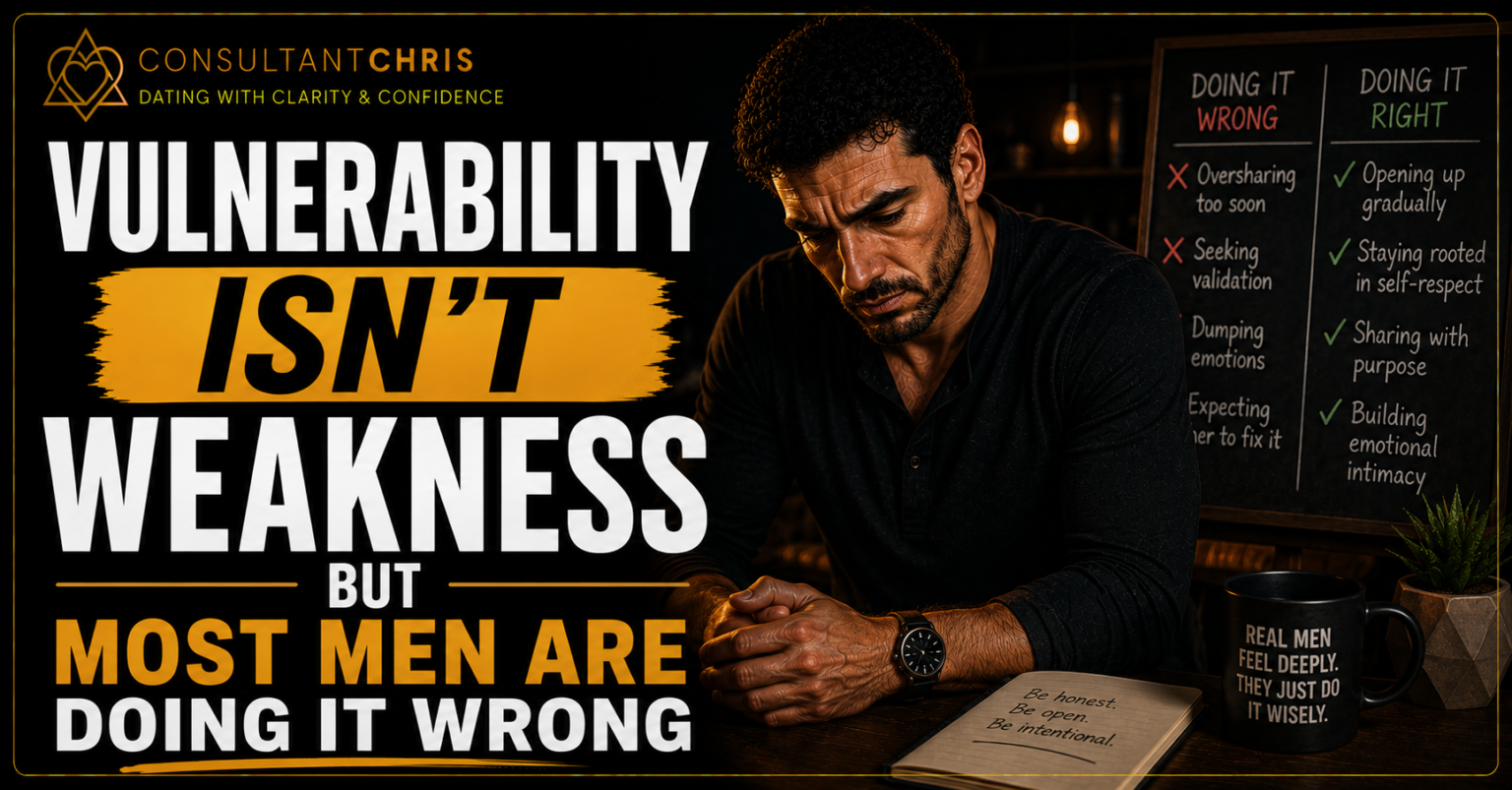
Somewhere in the last decade, the message got through to a lot of men: vulnerability is good. Be open. Share your feelings. Don’t be a closed-off emotional robot.
Which is true. Mostly.
The problem is that a lot of men heard that message and swung to a version of vulnerability that is doing them more harm than the wall they had before. They overshare on first dates. They trauma dump before trust is established. They perform emotional openness as a strategy the same way they used to perform confidence as a strategy and it lands just as hollow.
So I want to actually define what vulnerability is, what it isn’t, why it’s genuinely attractive when it’s done right, and why it pushes people away when it’s done wrong.
Because the distinction matters enormously, and it’s one that most of the mainstream conversation around men and vulnerability completely glosses over.
What Vulnerability Actually Is

Let me give you a definition that I think is actually useful: vulnerability is the willingness to be real without hiding. It says what’s true your joys, your fears, your uncertainty, your excitement without putting on a mask or performing a version of yourself designed to produce a specific reaction.
That’s it. That’s the whole thing.
Notice what it’s not. It’s not confessing your deepest wounds to someone you’ve known for forty-five minutes. It’s not leading with your failures and struggles as a way to seem relatable. It’s not emotional over-investment in someone you barely know, disclosed with an intensity that puts the other person in the uncomfortable position of managing your feelings.
Those things aren’t vulnerability. They’re anxiety expressed outward, or a strategy to create intimacy faster than trust has actually developed. Women can feel the difference immediately.
The Paradox That Makes It Work
Here’s the thing about genuine vulnerability that most men don’t realize: it comes from strength, not from weakness. And that’s exactly why it’s attractive.
When a man is able to say something honest about his experience not rehearsed, not strategic, just actually true from a place of groundedness rather than neediness, it lands as confidence. It signals that his self-worth is not contingent on your reaction. He’s not sharing because he needs you to validate him. He’s sharing because it’s true and he’s comfortable enough in himself to say it.
That combination honesty plus groundedness is what women are actually responding to when they say they find vulnerability attractive. They’re not attracted to exposure. They’re attracted to the security that allows someone to be exposed without collapsing.
I think about what I’ve heard from dozens of clients and the women they’ve connected with. The moments that created the biggest shifts in how a woman felt about a man were almost always small, honest moments. Not grand confessions. Just a guy being real about something small without making a big deal of it.
She asks how his week was and instead of the automatic ‘good, busy,’ he says: ‘Honestly, harder than I expected. I was working toward something that didn’t land the way I hoped.’ Then he asks about her week. No drama. No spiraling. Just a moment of honesty followed by genuine curiosity about her.
That’s it. That’s the whole move. And it creates more genuine connection than an hour of impressive highlights.
Why Men Either Over- or Under-Do It

The reason vulnerability goes wrong in both directions the closed-off wall and the over-sharer usually comes from the same root: an insecure relationship with one’s own emotional experience.
The man who built the wall did it because somewhere along the line, being emotionally open got him hurt, mocked, or dismissed. He learned that his feelings were liabilities. So he locked the door.
The man who over-shares, counterintuitively, is often in the same place. He’s been emotionally bottled up for so long that when he finds a context that seems safe for emotional expression, everything comes out at once. The dam breaks. And it overwhelms people who didn’t sign up to be his therapist.
Both of these men need the same underlying thing: a more secure, regulated relationship with their own emotional experience. The ability to feel things without being controlled by them. To share selectively and appropriately not because they’re calculating, but because they’re grounded enough to read the room and respond to what’s actually happening rather than what they need to release.
The Emotional Intelligence Connection
Self-regulation is one of the four pillars of emotional intelligence, and it’s the one most directly related to vulnerability done well.
Self-regulation doesn’t mean suppression that’s the wall, and it doesn’t work. It means having enough awareness of and relationship with your own emotional state that you can choose when and how to express it rather than being run by it.
A self-regulated man feels nervous before approaching someone. He notices the nervousness, acknowledges it internally, and walks over anyway. Maybe he even says, with a half-smile: ‘I’ll be honest, I was a little nervous to come say hi. But you seemed interesting enough to risk it.’ That’s self-regulation enabling genuine vulnerability. The nervousness is real. The share is honest. The delivery is grounded. She doesn’t take on his anxiety — she appreciates his realness.
Without self-regulation, the same nervousness either gets shut down entirely (wall) or gets shared at a volume that makes her uncomfortable (over-share). The middle path is the one that actually works, and it requires developing the internal capacity to be with your own feelings without either suppressing or dumping them.
Practical Ways to Start

The micro-truth challenge is one of the simplest practices I recommend. Once a day, share one small honest thing you’d normally default to hiding. Not something heavy just something real. Your actual reaction to something. A small thing that was hard. Something you genuinely found funny rather than the polished version of yourself you usually present.
Then notice the response. Not to collect data points just to start building evidence in your own experience that being real is usually received better than being curated. Over time, that evidence recalibrates the fear that keeps the wall up.
The second practice is learning to share from strength rather than pain. This means being able to talk about difficult experiences in a way that communicates growth and self-awareness rather than unresolved emotion. ‘I went through a difficult divorce a few years ago it taught me a lot about what I actually want and what I was avoiding’ is vulnerability done from strength. The same information delivered as an open wound is vulnerability done from pain. The content is the same. The emotional posture is completely different. And women respond to the posture, not just the content.
The Real Reward
When vulnerability is done right real, grounded, calibrated to the level of trust that’s been established it creates something in a relationship that nothing else creates. It creates the experience of being actually known rather than just approved of.
Most men have spent their dating lives trying to be approved of. Impressive. Put-together. The best version of themselves on permanent display. And they’ve ended up in relationships that feel thin or exhausting to maintain because they’re built on performance rather than reality.
The man who can be genuinely real in doses, from a grounded place, without needing a particular reaction becomes the man women want to come back to. Not because he’s broken open, but because he’s actually there. Present. Known.
That’s what real connection feels like. And it starts with being willing to be seen.
Doing vulnerability well is a skill, not just an intention. Emotionally intelligent men tend to get this balance right, and it shows most clearly in how they listen.
