


There’s a conversation I’ve had with more men than I can count, and it usually starts the same way.
He built a great career. He was the kind of man anyone would want their daughter to marry — responsible, driven, financially stable, genuinely good-hearted. He got married when the timing felt right. He worked hard to provide. And then somewhere between year five and year fifteen, the marriage quietly fell apart. She said she felt alone. That he was always somewhere else mentally. That she couldn’t reach him.
He didn’t see it coming or if he did, he didn’t know what to do about it.
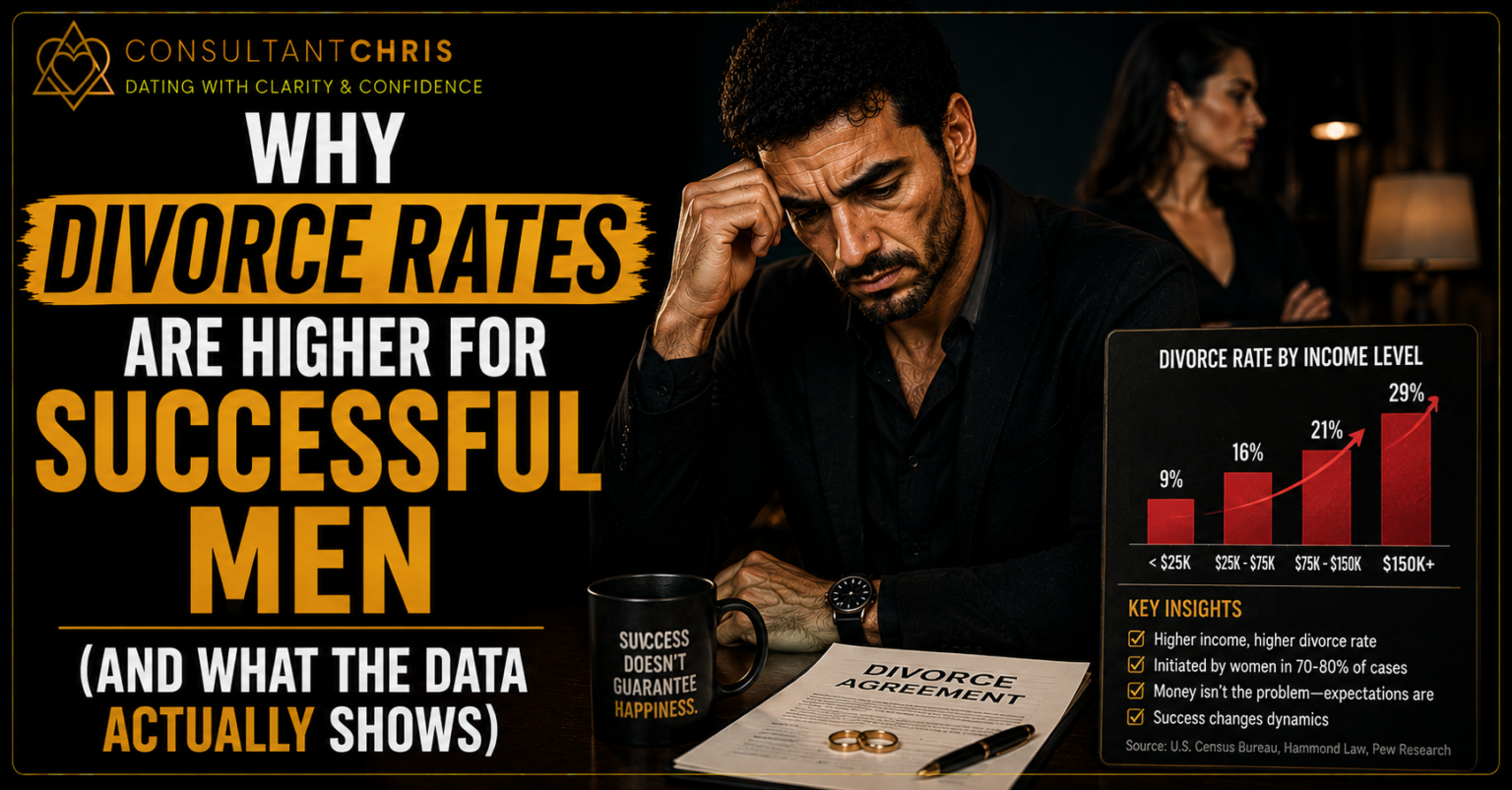
I’m not going to throw a single dramatic statistic at you and tell you the whole story lives in a number. The data on divorce is complex, contested, and highly dependent on how you define success and which variables you control for. But there is a consistent pattern in the research and in my direct experience working with high-achieving men that is worth taking seriously.
And that pattern has a clear explanation.
What the Research Actually Shows

Studies examining the relationship between income, professional status, and divorce outcomes reveal a nuanced picture. Some research suggests that very high-earning men in certain industries have above-average divorce rates — not below average, as many might expect. Other studies show that while financial stress is a top predictor of divorce overall, its removal doesn’t eliminate the problem for high earners. Something else is doing significant work.
That something else, when researchers and therapists dig into the qualitative data, tends to come back to the same cluster of issues: emotional unavailability, communication breakdown, and a widening gap between professional success and relational competence.
In other words: the same conditions that made these men professionally exceptional the compartmentalization, the drive, the ability to prioritize outcomes over process created the conditions for relational failure at home.
The Career Success Trap in Marriage
Here is the dynamic I see play out repeatedly.
A high-achieving man brings the same orientation to his marriage that he brings to his work. He provides. He solves problems. He executes on responsibilities. By every measurable standard, he is doing his job as a husband.
What he often doesn’t do because nobody ever trained him to do it, and because his professional world never required it is show up emotionally. Be present in conversations that aren’t logistical. Make his partner feel genuinely seen and understood rather than taken care of. Create the kind of emotional warmth and depth that sustains a long-term relationship through the inevitable difficult periods.
His partner, over time, starts to describe the experience in words that confuse him. She says she feels lonely even when he’s in the room. That she can’t reach him. That she’s been trying to tell him something for years and he keeps responding with solutions when she just wants him to listen.
He genuinely doesn’t understand what she’s asking for. Not because he doesn’t care often he cares enormously but because the emotional register she’s operating on is one he was never taught to access.
Think of it like having a conversation in a language you never learned. Her emotional world is real and present and she’s been speaking it to him for years. He hears the words but not the meaning. And that gap, sustained over years, becomes a chasm that’s very hard to cross after it’s formed.
Why High Achievers Specifically Struggle With This

The traits that drive professional success and the traits that sustain emotional intimacy are not the same traits and in some important ways, they’re in direct tension with each other.
Compartmentalization the ability to put feelings aside and focus on the task at hand is enormously valuable professionally. In a relationship, it means your partner knows you’re capable of deep emotion at work but shuts it down at home. That’s not neutral. Over time, it reads as rejection.
Outcome orientation the habit of focusing on results and efficiency turns every relationship conversation into a problem to be solved rather than a moment to be present in. She doesn’t want your solution. She wants your attention. These are different things, and the high achiever who conflates them spends years being useful to his partner in ways she didn’t ask for.
Emotional suppression often ingrained from early in life means that his own emotional world is largely inaccessible to him, let alone to her. He can’t give what he doesn’t have access to. And that inaccessibility, from her perspective, feels like he simply doesn’t care.
What This Means for Men After Divorce or Separation
If you’ve already been through a divorce or a long-term relationship breakdown, a lot of what I just described might land with uncomfortable recognition.
The worst outcome of that recognition is guilt the sense that you were fundamentally defective as a partner. That’s not a useful or accurate conclusion. A more useful framing is this: you brought genuine care and commitment to a relationship while lacking a specific skill set that the relationship required. That’s not a moral failure. It’s a skill gap. And unlike character, skill gaps can be closed.
The men I work with who have been through divorce often make the most meaningful progress, because the cost of the gap has been made real to them. They’re not working on theory. They’re working with lived knowledge of exactly how much this matters and that creates a level of commitment to the work that produces real results.
Emotional Intelligence as Relationship Insurance

I want to be careful not to oversell this, because relationships are complex and no single skill set is a guarantee of anything. But I will say this directly: of all the factors that predict long-term relationship satisfaction and stability, the research consistently points to emotional intelligence as one of the most significant.
Specifically: the ability to stay emotionally present under stress, to communicate what you’re feeling in ways your partner can receive, to listen in a way that makes someone feel genuinely understood, and to regulate your own emotional responses rather than outsourcing them. These aren’t soft skills. In the context of a long-term relationship, they’re load-bearing skills. And they’re developable at any point in life.
Success brings its own relationship risks that rarely get discussed. Career identity is usually at the center of it, and financial transparency tends to be where the cracks first show.
The men who build these capabilities don’t just have better dating lives. They have better marriages. Better relationships with their kids. Better friendships. Better professional relationships. The return on this investment is not narrow it ripples into every area of life that involves another human being.
And that, honestly, is most of life.
