


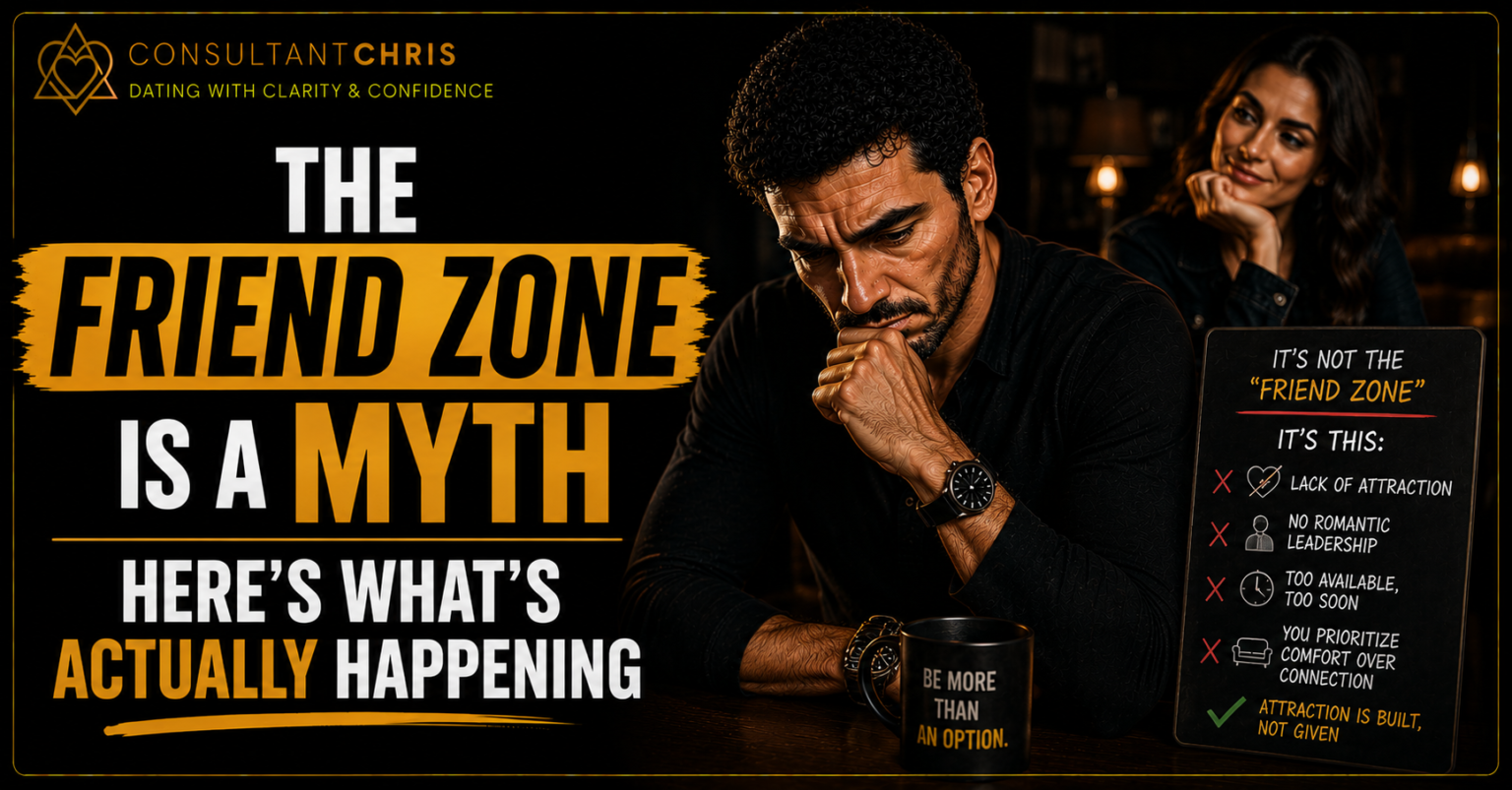
I want to say something that might be unpopular in certain corners of the internet.
The friend zone, as most men conceptualize it, doesn’t exist.
Before you close the tab hear me out, because I’m not dismissing the experience. The experience is real. You invested time, energy, and genuine feeling into someone who didn’t see you romantically. That’s painful. That’s worth taking seriously.
What I’m challenging is the framework most men use to explain it because that framework leads them directly away from understanding what actually happened, and directly away from being able to change it.
The friend zone, in its popular conception, is something that happens to you. A place she puts you, against your will, unfairly. A sentence handed down by someone who didn’t give you a fair shot. And the problem with that framing is that it locates all the power with her and none of it with you. Which means there’s nothing you can change just circumstances that either go your way or don’t.
That’s not what’s actually happening. And understanding what actually is happening is worth a lot more than having a convenient label for the outcome.
What’s Really Going On

Attraction is not a decision. It’s not something a woman withholds from you out of preference for unavailable men or some perverse desire to overlook the ‘good ones.’ It’s an emotional and physiological response that either develops or doesn’t and it develops based on specific conditions, most of which are within your influence.
When a man ends up in what he calls the friend zone, one of a relatively small number of things usually happened.
The most common: attraction was never signaled from his side. He was friendly, supportive, present but those behaviors, in the absence of anything that communicated romantic interest, got correctly read as friendship. She responded accordingly. He interpreted that response as a verdict on his desirability rather than a natural reaction to the signals he was sending.
The second common pattern: there was a window for attraction to develop, and it closed. Not because she made a permanent decision, but because the relational dynamic got established as platonic before any spark had a chance to build. Dynamics have inertia. Once the emotional register between two people is set as ‘safe and friendly,’ shifting it requires real and deliberate effort and most men either don’t know how to make that shift or are too afraid of losing the friendship to try.
The third pattern and this one is harder to hear is that she did feel something early on, and then something happened that switched it off. A moment of neediness. An emotional over-investment that registered as desperation. A failure to hold any kind of tension or challenge in the dynamic. Attraction requires a certain amount of uncertainty and polarity to stay alive. Friendliness, agreeableness, and constant availability can actively dissolve it.
The Authenticity Problem
Here’s where it connects directly to what I teach.
One of the most consistent patterns I see in men who end up in this dynamic is that they don’t show up as full human beings in the presence of someone they’re attracted to. They show up as the safest possible version of themselves agreeable, supportive, never challenging, never asserting a real opinion, never creating any friction whatsoever.
This comes from a good place. They don’t want to risk the connection. They don’t want to say something that pushes her away. They’ve decided, consciously or not, that the safest strategy is to be undemanding and universally positive.
But here’s what that strategy produces from the other person’s perspective: a pleasant presence with no edges. Someone genuinely nice to be around who somehow doesn’t feel like a potential partner. Because partners have opinions. Partners push back occasionally. Partners have their own interior life that isn’t entirely organized around accommodating yours.
The self-erasure that men think is the safe strategy is actually the thing that makes attraction impossible to build. You can’t be attracted to someone who isn’t fully there.
What Emotional Intelligence Has to Do With It

Being emotionally intelligent in a dating context doesn’t mean being emotionally available in every direction at once. It means being self-aware enough to know what you actually want and grounded enough to let that be visible and it means reading the dynamic accurately enough to respond to what’s actually happening rather than performing a strategy.
Self-awareness tells you: I’m attracted to this person and I’m behaving like I’m not, because I’m afraid. That’s information. You can do something with it.
Empathy tells you: she’s reading our dynamic as friendship right now. What would have to change for her to have a different experience of this?
Self-regulation tells you: the fear of losing the friendship is real, but shrinking around it is making me someone she can’t be attracted to. I can stay grounded through the discomfort of showing her who I actually am.
These aren’t tricks. They’re not techniques for manufacturing attraction. They’re the internal moves that allow you to actually show up in a way that gives attraction a chance to develop rather than managing the dynamic so carefully that you’ve optimized yourself out of it.
A Honest Word on Outcomes

Sometimes you show up fully, signal clearly, bring your real self into the dynamic — and she still isn’t romantically interested. That happens. Not every person is going to be attracted to you regardless of what you do, and that’s true for everyone.
But there’s a significant difference between ‘she’s not interested’ and ‘she never had the chance to be interested because I never gave her accurate information about who I was and what I wanted.’
The first is just reality. The second is a pattern that you can change and changing it starts with understanding what you’re actually doing when you fade into the background and call the result the friend zone.
You’re not a victim of where she put you. You’re in a dynamic you co-created. Which means you have more agency in this than the narrative you’ve been carrying suggests. Use it.
Once you see what’s really going on here, the fix tends to be less about tactics and more about one skill that changes everything, and knowing how to approach a woman well helps you avoid landing in this position in the first place.
