


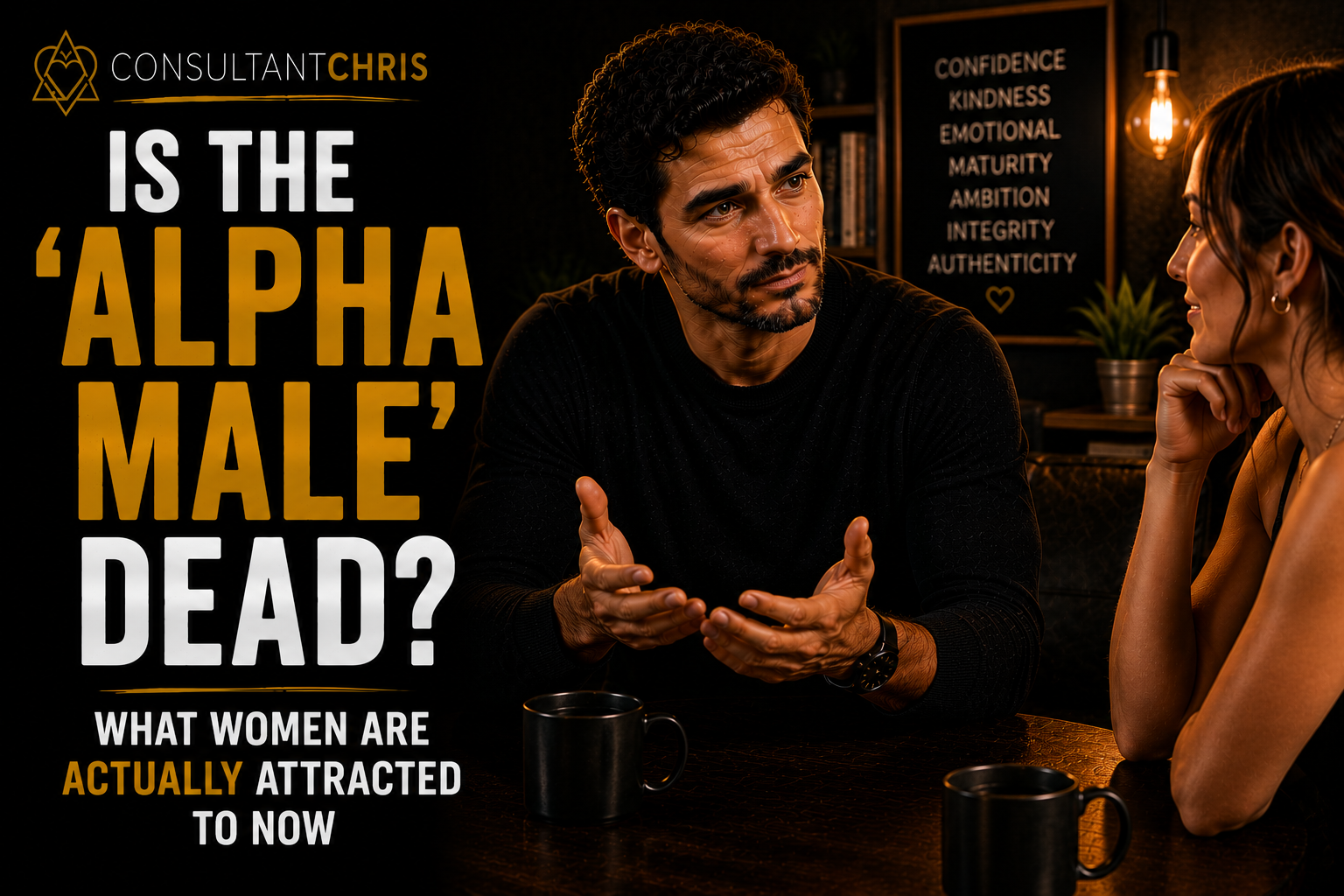
The alpha male concept has had a long run in men’s dating advice, and I think it deserves an honest autopsy rather than either dismissal or defence.
The appeal was always clear. A simple, legible framework for what to become. Dominant, decisive, high status, emotionally unperturbed. Be the man at the top of the hierarchy and attraction follows. It mapped neatly onto competitive male instincts and it gave clear targets to work toward.
The problem is that it was built on a fundamental misreading of both evolutionary biology and female attraction — and the men who followed it most faithfully tended to end up either alone or in relationships that looked good from the outside and felt hollow from the inside.
Where the Alpha Male Concept Went Wrong

The original research on alpha behaviour in primates particularly wolves, where the alpha concept was popularised has been significantly revised by the scientists who conducted it. David Mech, who popularised the term alpha wolf, spent years attempting to retract that framework after better research showed that wolf packs are actually family units led by experienced parents, not dominance hierarchies maintained through force. The alpha male model was based on observing wolves in artificial captive conditions that produced stress behaviours not representative of their natural social organisation.
The human application was built on shaky foundations from the start. And the specific version of alpha behaviour that most men’s dating content promoted emotional unavailability, competitive dominance, the performance of not caring is the opposite of what the actual human attraction research consistently shows women respond to most.
What the Research Actually Shows

Multiple large-scale studies on male attractiveness across cultures show that the traits women consistently weight most heavily are: emotional stability and groundedness, intelligence and competence, genuine kindness that is not performed, and the ability to make them feel safe. Dominance registers as attractive specifically when it is paired with warmth without warmth, dominance registers as threatening rather than compelling.
The 2012 study in Hormones and Behavior that I have referenced in previous blogs is worth noting again here: women rated men most desirable when they projected both security and unpredictability. Security, notably, is not dominance. Security is the quality of being reliably present and emotionally grounded in a way that makes a woman feel safe. That is a fundamentally different thing from the status-projection and emotional performance that the alpha male framework promotes.
Tinder’s 2026 data shows 56% of daters prioritising honest conversation and 45% wanting more empathy. Neither of those qualities appears in the alpha male framework. Both of them are core emotional intelligence competencies.
What Has Replaced It
The archetype that is actually producing results in 2026 is not the alpha male. It is what I would call the grounded man someone with genuine self-possession, clear values, emotional availability, and the ability to be fully present in a connection without performing or managing his image.
This man leads in the sense of creating direction and safety without dominating. He is decisive without being rigid. He has genuine confidence without requiring external validation to maintain it. He can be moved by things by genuine feeling, by beauty, by a real moment in a conversation without being destabilised by them. He is warm without being a pushover. He holds his own without needing to diminish others.
That archetype requires emotional intelligence, not the suppression of it. The man who has done the inner work who knows himself, regulates himself, genuinely empathises with others, and shows up with authentic presence is more attractive than any performance of status or dominance. Not because the rules changed. Because the rules were always what they are. The alpha framework simply had the wrong rules.
The label may be fading but the qualities underneath it still matter. Beyond alpha and beta breaks this down further, and what women actually want has the current data behind it.
