


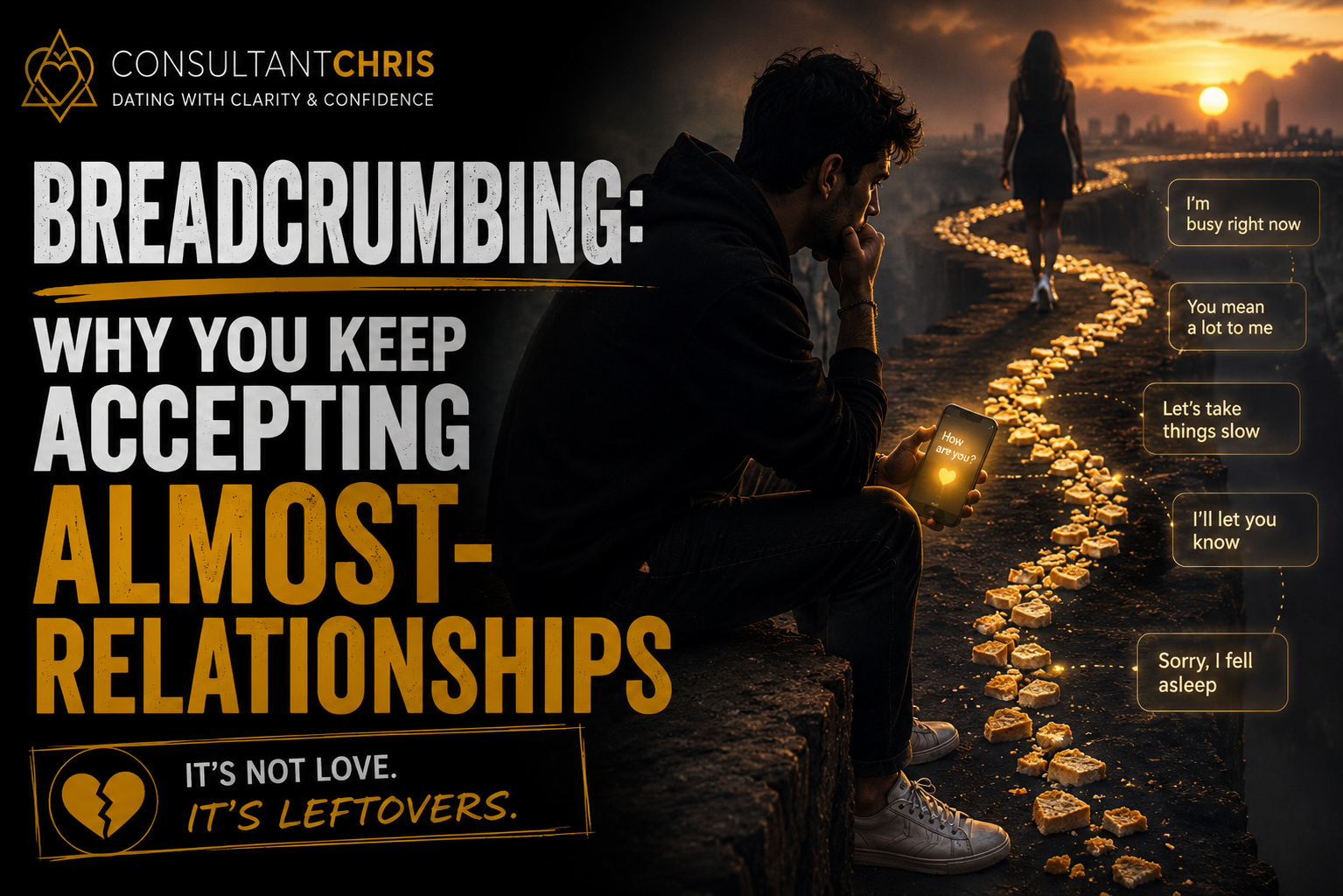
There is a specific kind of frustration that comes from a particular dating dynamic one that’s distinct from ghosting, distinct from rejection, and in some ways more draining than either.
It’s the experience of someone keeping you just engaged enough that you stay, while never actually committing enough to give you what you actually want. A message that arrives just when you’ve almost decided to move on. A warm moment that gets followed by days of distance. Enough heat to keep you interested, never enough substance to build anything real.
This is breadcrumbing. And it’s one of the most Googled dating terms of the last two years for a reason because it describes an experience that is extraordinarily common and extraordinarily difficult to exit, even when you can see it clearly.
I want to talk about what it actually is, why smart men end up in it and stay longer than makes sense, and what getting out of it requires.
What Breadcrumbing Actually Is

Breadcrumbing is a pattern of intermittent, low-investment communication that maintains your interest and emotional availability without any real commitment or reciprocal investment from the other person. The crumbs the occasional text, the warm interaction that comes out of nowhere, the suggestion of something more that never materialises are just enough to keep you on the hook.
The person doing it is not always doing it deliberately or maliciously. Sometimes they genuinely like you but aren’t in a position to offer more and rather than being honest about that, they manage the connection at low cost. Sometimes they’re keeping options open. Sometimes they’re simply conflict-avoidant enough that letting the connection fully go feels more uncomfortable than letting it hover indefinitely.
Regardless of intent, the effect on the person receiving the breadcrumbs is the same: you spend emotional energy on something that isn’t going anywhere, your attention and availability are occupied by someone who isn’t fully showing up, and the intermittent reinforcement, the unpredictable crumbs creates a low-grade anxiety that’s difficult to disengage from even when your rational mind knows you should.
Why the Intermittent Reinforcement Is So Hard to Leave

This is where psychology is directly relevant, and understanding it is genuinely useful.
Intermittent reinforcement, unpredictable, occasional rewards is one of the strongest conditioning mechanisms known to behavioural science. It’s why slot machines are so compelling. It’s why the variable-ratio schedule of a crumb after a period of silence is neurologically stickier than consistent, reliable attention.
When someone is consistently warm and available, your brain habituates. It’s pleasant, but it doesn’t create the same hook. When someone is intermittently warm, disappears for a while, then sends something that makes you feel something, then disappears again your nervous system gets caught in an anticipation loop. You’re not chasing the person. You’re chasing the resolution of the uncertainty. And that loop is very hard to break through reasoning alone.
This is important because it means the fact that you’re stuck in a breadcrumbing dynamic isn’t evidence of weakness or stupidity. It’s evidence that the human brain responds to intermittent reinforcement in a very predictable way. Knowing that doesn’t immediately free you from it, but it does help you stop blaming yourself for the difficulty of leaving.
Why High-Achieving Men Are Particularly Vulnerable
The man I work with most often analytical, driven, high-performing has a specific vulnerability to this dynamic that’s worth naming.
First, he tends to be solution-oriented. When something isn’t working, his instinct is to figure out why and fix it. Breadcrumbing gives that instinct somewhere to go, he analyses the pattern, adjusts his approach, waits to see if the adjustment produces a different result. He can stay in this analysis-and-adjustment loop for months or years without it ever producing genuine change, because the problem isn’t his approach. The problem is the dynamic itself.
Second, he often has a scarcity mindset about connection. If this person is one of the few who has produced real feeling in him, losing access to those crumbs even poor substitutes for actual connection, feels like losing something significant. The fear of going back to nothing keeps him accepting less than he deserves.
Third, he’s often conflict-avoidant in intimate contexts. Having the direct conversation that would force clarity ‘where is this actually going?’ feels risky enough that he avoids it. And avoidance keeps him in the dynamic indefinitely.
What Getting Out Actually Requires
The exit from breadcrumbing is not complicated in description. It is difficult in execution because it requires you to do something that feels counterintuitive when you’re emotionally invested: stop responding to the crumbs.
Not dramatically. Not with a long explanation or a pointed message about what they’ve been doing. Just a quiet, deliberate withdrawal of your availability. You stop being the person who’s reliably there when they surface after a silence. You stop treating the occasional warm message as a sign that something real is developing. You start treating your own time and emotional energy as worth protecting.
The self-awareness piece: be honest about what you actually want from this. Not what you hope it might become. What it actually is right now. If what it actually is right now isn’t what you want, that’s the information you need to act on.
The self-regulation piece: the urge to respond when a crumb arrives especially after a period of silence is almost automatic. Pausing that automatic response, taking thirty seconds before you reply, asking yourself whether this response is coming from genuine desire or from the anxiety of the intermittent loop that pause is where you get your agency back.
You deserve more than crumbs. And the first step to getting more is being willing to stop eating them.
Accepting less usually comes from somewhere deeper than the situation itself. Self sabotage often plays a role here, and this is exactly the pattern behind situationships that never quite become real.
