


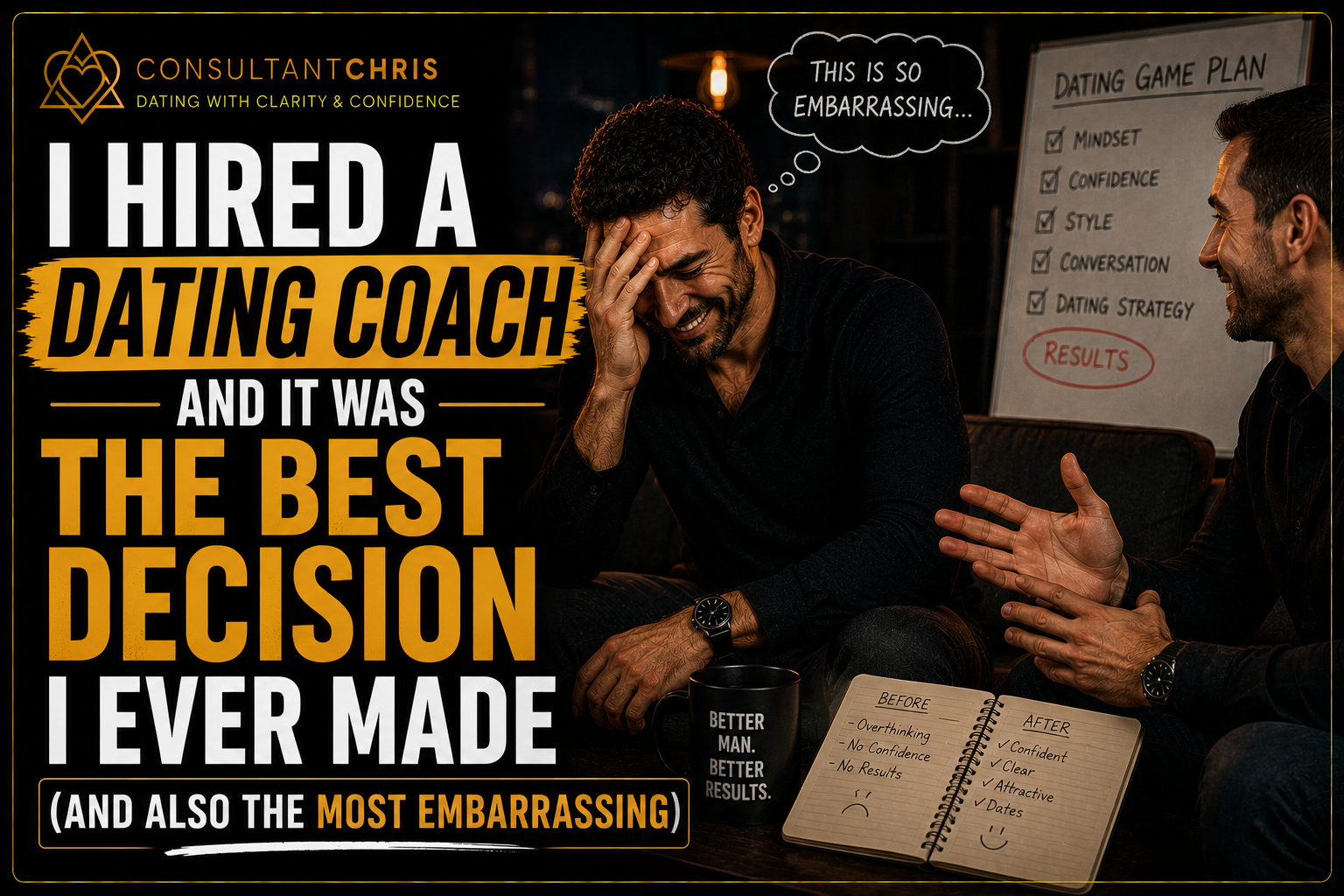
I want to talk about the thing nobody in this space talks about honestly.
The shame.
Not just the fear of rejection, not just the awkwardness of dating in your thirties or forties, the specific, gut-level shame of admitting that you need help with this. The thought that runs through the back of your mind: I’m an intelligent, capable adult. I’ve built a career. I’ve handled real challenges. Why can’t I figure out dating on my own?
That thought is so common among the men I work with that I’d be surprised to meet a coaching client who hasn’t had it. And I understand it completely. Because the cultural message we’ve received our whole lives is that needing help with relationships is weakness. That a real man should just know this stuff. That asking for guidance in the romantic domain is somehow more embarrassing than asking for guidance in literally any other domain.
It’s a strange belief when you look at it directly. But it’s real, and it keeps a lot of genuinely good men stuck for years longer than they need to be.
So I want to walk through this honestly, what the shame is actually about, what coaching actually is, and why the men who get past the embarrassment and do the work almost universally say it was one of the best decisions they made.
Why This Feels More Embarrassing Than It Should

Think about the other areas of life where professional guidance is not just accepted but expected.
You hire a financial advisor to manage wealth you’ve worked hard to build. Nobody thinks less of you for that in fact, not having a financial advisor when you have serious assets would be considered negligent. You work with a personal trainer when you want to get in shape, because you know that expertise and accountability produce better results than figuring it out alone. If you were learning a new skill for your career, you’d pay for courses, find mentors, invest in your development without a second thought.
The logic is the same in every one of those domains: you have a goal that matters to you, an expert can help you get there faster and with fewer costly mistakes, and the investment is worth it. Straightforward.
Dating and relationships are, for most people, among the most important parts of life. We’re talking about who you share your life with, your emotional wellbeing, your legacy. And yet somehow, getting structured help to improve in this area carries a stigma that hiring a financial advisor does not.
That discrepancy isn’t logical. It’s cultural. And I’d argue it’s a cultural message that serves nobody except maybe the people selling you the tenth dating book that isn’t working.
What Coaching Actually Is (And Isn’t)

Let me clear up a misconception that I run into all the time, because I think it’s part of what feeds the shame.
Dating coaching is not someone telling you how to manipulate women into liking you. It’s not scripts, it’s not tricks, it’s not a weekend bootcamp where you approach a hundred strangers and force yourself through social anxiety with brute effort.
What it actually is, at least the way I do it, is a structured process of developing the emotional skills that create genuine connection. Self-awareness, understanding your own patterns, your triggers, the ways you unconsciously close yourself off in dating situations. Self-regulation, being able to stay present and grounded even when anxiety or overthinking kicks in. Empathy learning to actually read and respond to the person in front of you. And real-world practice with feedback, so that what you’re learning in sessions starts to show up in your actual life.
It’s also accountability. There’s a reason high performers in every field work with coaches. Not because they lack intelligence or capability, but because a skilled outside perspective and a structured framework produces faster and more durable results than self-directed effort alone. That’s just how skill development works.
The Men Who Come to Me
I want to describe the typical man who ends up working with me, because I think it might be clarifying.
He’s usually somewhere between 30 and 55. He has a career he’s proud of often something that requires significant expertise, whether that’s medicine, law, engineering, finance, or entrepreneurship. He’s thoughtful, self-aware enough to recognize that something isn’t working, and frustrated because he can’t solve this the way he solves other problems.
He’s usually tried the obvious things apps, confidence books, maybe some YouTube content and found them either unhelpful or actively counterproductive. He’s not looking for tricks. He’s looking for something that actually addresses the real problem.
And the real problem, almost universally, is an emotional intelligence gap. Not a moral failure. Not a fundamental defect. A trainable skill set that nobody ever systematically taught him. The same system that trained him to be excellent in his career simply never addressed this, and he’s been trying to figure it out alone with inadequate tools.
These are not men who should be ashamed of needing help. They’re men who were let down by a culture that taught them to suppress their emotional development and then blamed them for the results.
What Changes When You Do the Work
I’ll be honest with you about what shifts when men go through a real coaching process. It’s not that they suddenly become someone different. It’s that they become more fully themselves.
The overthinking quiets down. Not because they stop caring about dating, but because they develop enough genuine skill and confidence that the anxiety loses its grip. They stop feeling like they’re performing in every interaction and start feeling like they’re actually present. Women start responding differently not because they’re using different lines, but because they’re putting out a different energy. Calm. Grounded. Real.
One of the most consistent things I hear from clients after going through the process is some version of: ‘I can’t believe I waited this long.’ Not because the work was easy, but because the result actual progress, actual connection, actually understanding what was getting in their way was so much more accessible than they thought.
The embarrassment they felt about seeking help looks very different in retrospect. Because the real embarrassment, they tell me, would have been spending another five years in the same patterns out of pride.
A Note on Pride

Pride is useful. It drives performance. It protects dignity. But there’s a version of pride that becomes self-defeating the kind that would rather keep struggling quietly than admit that help exists and would actually work.
The most high-performing men I know are also the most willing to seek out expertise when they need it. That’s not a coincidence. The willingness to identify a gap and fill it, without shame and without ego getting in the way, is a significant part of what makes them exceptional.
If your dating life isn’t where you want it to be, and you’ve been trying to fix that on your own for a while without meaningful progress, that information is worth something. It means the approach needs to change. And changing your approach is not weakness it’s intelligence in action.
Not every coach is worth the money, but the right one changes everything. Whether coaches are a scam is worth reading before you hire one, and therapy before dating is a related question a lot of men ask too.
