


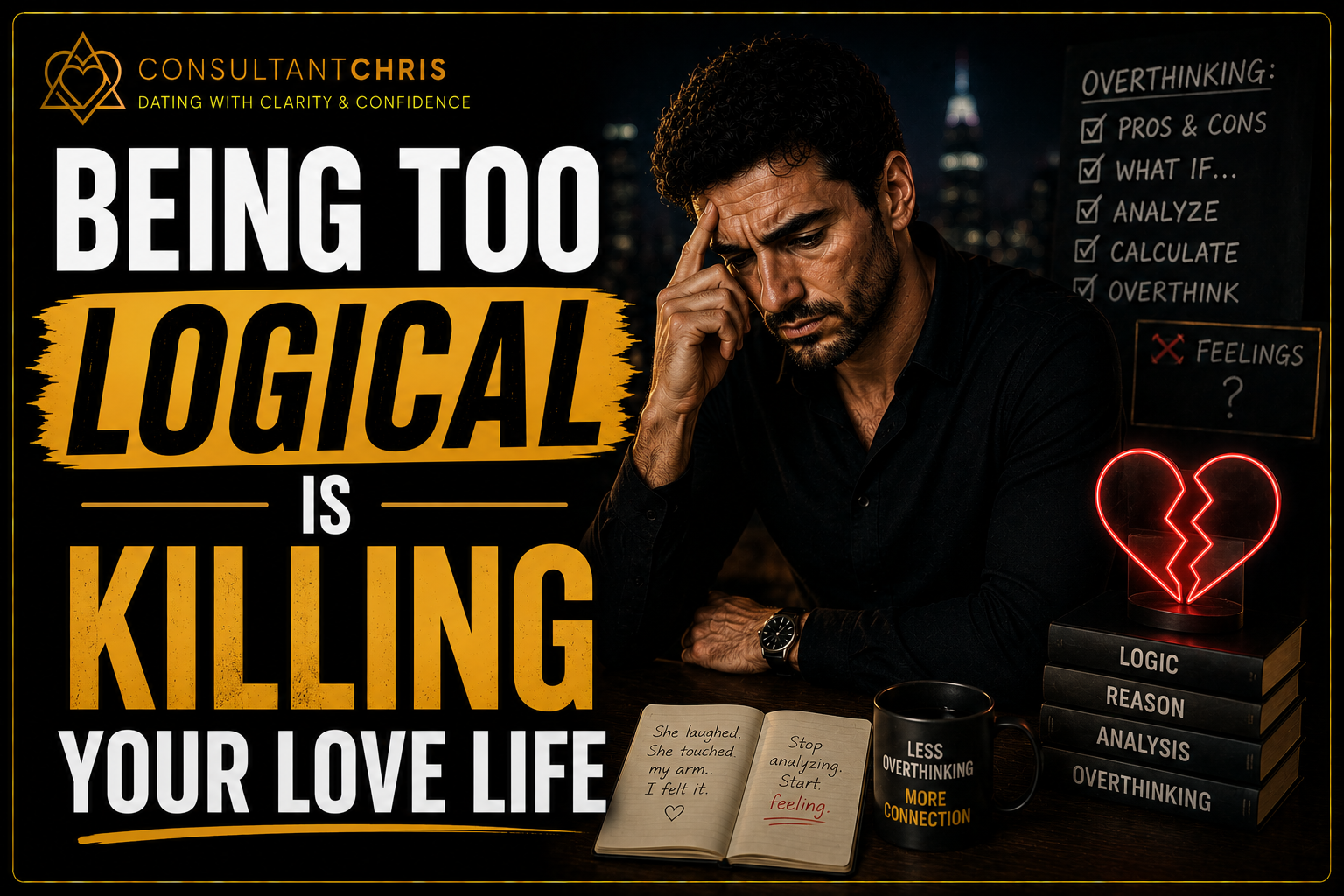
I want to start with something you’ve probably never been told and might not want to hear.
Your biggest asset is also your biggest problem in dating.
That analytical mind. The one that got you through school faster than most people. The one that built your career. The one that solves problems in your sleep and optimizes systems before breakfast. That same mind when applied to dating can create a kind of relational paralysis that’s nearly impossible to get out of on your own.
I’ve seen it in the doctors, engineers, lawyers, and executives I work with. These are men operating at the top of their professional fields. Rigorous thinkers. High performers by every external measure. And in dating, they’re running simulations instead of having conversations. They’re diagnosing relationships instead of being in them. They’re so busy evaluating the situation that they’re not actually present in it.
If this sounds familiar, here’s the good news: it’s not a character defect. It’s a skill mismatch. And skill mismatches can be corrected.
The Problem With Applying Logic to Attraction

Let me be precise about what I mean, because this isn’t an argument against intelligence. It’s an argument against applying the wrong tool to the wrong task.
Logic is extraordinarily useful for problems with defined variables, predictable inputs, and consistent rules. Designing a product. Building a financial model. Diagnosing a medical condition. These are domains where analytical rigor produces better outcomes the more carefully it’s applied.
Attraction doesn’t work this way. It operates in a parallel universe with entirely different rules.
Attraction is driven primarily by emotional state hers and yours. It’s shaped by presence, energy, tonality, micro-expressions, and dozens of non-verbal signals happening in real time. It’s not linear. It’s not predictable. You cannot optimize your way into it.
The man who approaches a woman with a carefully planned conversational strategy, who monitors his own performance in real time, who analyzes her every response for signal and subtext, he might be doing everything technically right and still come across as robotic and distant. Because the analysis is happening in a register that is completely invisible to the interaction itself.
She doesn’t experience your analysis as intelligence. She experiences it as absence. You’re not there with her. You’re somewhere in your head, running the model.
The Overthinking Spiral, How It Plays Out

Here’s a pattern I see constantly.
He meets a woman he’s genuinely interested in. The interest itself creates anxiety. The anxiety activates the analytical brain. His brain starts generating questions: Is she actually interested? What’s the right amount of time to wait before texting? If she responds in under ten minutes, does that mean X? If her message was short, does that mean Y? What’s the optimal approach to asking her out, too casual looks uninterested, too formal looks try-hard…
By the time he actually engages with her, he’s made forty decisions, run through thirty scenarios, and arrived at a version of himself that is thoroughly exhausted by the effort of seeming natural. She can feel the effort. It doesn’t read as care, it reads as anxiety. And anxiety is not attractive.
Contrast this with the man who is genuinely present. He’s not running analysis. He’s actually listening to her, responding to what she’s saying, adjusting in real time based on her energy and the natural flow of the conversation. He’s relaxed not because he doesn’t care about the outcome, but because he’s not making the outcome the primary object of his attention.
That ease is magnetic. And it’s almost entirely a function of getting out of your head and into the actual moment.
What Emotional Intelligence Has to Do With It
This is where EQ comes in directly.
Emotional intelligence, specifically the pillars of self-awareness and self-regulation is what allows you to notice the analytical spiral starting and interrupt it before it takes over. Self-awareness tells you: I’m in my head right now. I’m monitoring the situation instead of being in it. Self-regulation gives you the ability to bring yourself back, to breathe, to drop the evaluation, to re-enter the actual conversation.
This isn’t mysticism. It’s a trainable cognitive skill. Athletes train it. Surgeons train it. High-performance professionals in any field where real-time responsiveness matters have developed versions of this capacity.
In dating, it’s the difference between a man who is interesting to talk to and one who somehow feels like a lot of work. The difference is almost entirely about where his attention is pointed, at her, or at himself monitoring the interaction.
The Specific Habits That Make This Worse

Post-Conversation Autopsies
Going home and replaying every exchange, analyzing what you should have said, looking for the moment things went sideways, this reinforces the monitoring habit without producing any usable insight. It feels productive. It isn’t.
Researching Instead of Doing
Reading another ten articles about what women want. Watching another ten videos about attraction. Consuming more information as a substitute for getting out and actually practicing. The analytical brain loves this because it feels like preparation. It’s often avoidance.
Trying to Understand Her Instead of Experiencing Her
There’s a difference between empathy which involves actually feeling into another person’s experience and analysis, which involves trying to decode and categorize that experience. One creates connection. The other creates distance. When you’re spending a date trying to understand her psychologically, you’re not actually with her.
How to Actually Use Your Intelligence in Dating
I want to be clear: I’m not suggesting you become dumber. Your intelligence is genuinely attractive. Intellectual engagement, the ability to hold a real conversation, the depth that comes from someone who actually thinks
The goal isn’t to suppress your analytical mind. It’s to develop the other half of the intelligence equation the emotional half so that you have the full range available to you.
In practice, this means: before a date, do whatever you need to do to get out of evaluation mode and into your body. Exercise helps. Brief mindfulness practices help. Getting genuinely curious about the person you’re about to meet not strategically, but actually helps.
During the interaction, practice keeping your attention on her rather than on your performance. Notice what she’s actually saying. Notice her energy. Let yourself respond to what’s actually happening rather than what you predicted would happen.
After, resist the autopsy. Notice how you felt during the interaction. That feedback is more useful than any analysis you could construct.
The Bottom Line
Your brain is an extraordinary tool. In the wrong context, any tool becomes a liability.
The work I do with men isn’t about making them less intelligent. It’s about building the emotional intelligence that balances and completes the analytical intelligence they already have. When both are developed, you become something rare: a man who can hold a serious conversation and who actually makes people feel understood. A man who has substance and presence simultaneously.
That man doesn’t struggle in dating. That man gets chosen.
Stop running simulations. Start showing up.
Overthinking rarely gets you the outcome you’re aiming for. Vulnerability is usually the actual fix, and this pattern connects closely to three fears most men never name out loud.
