


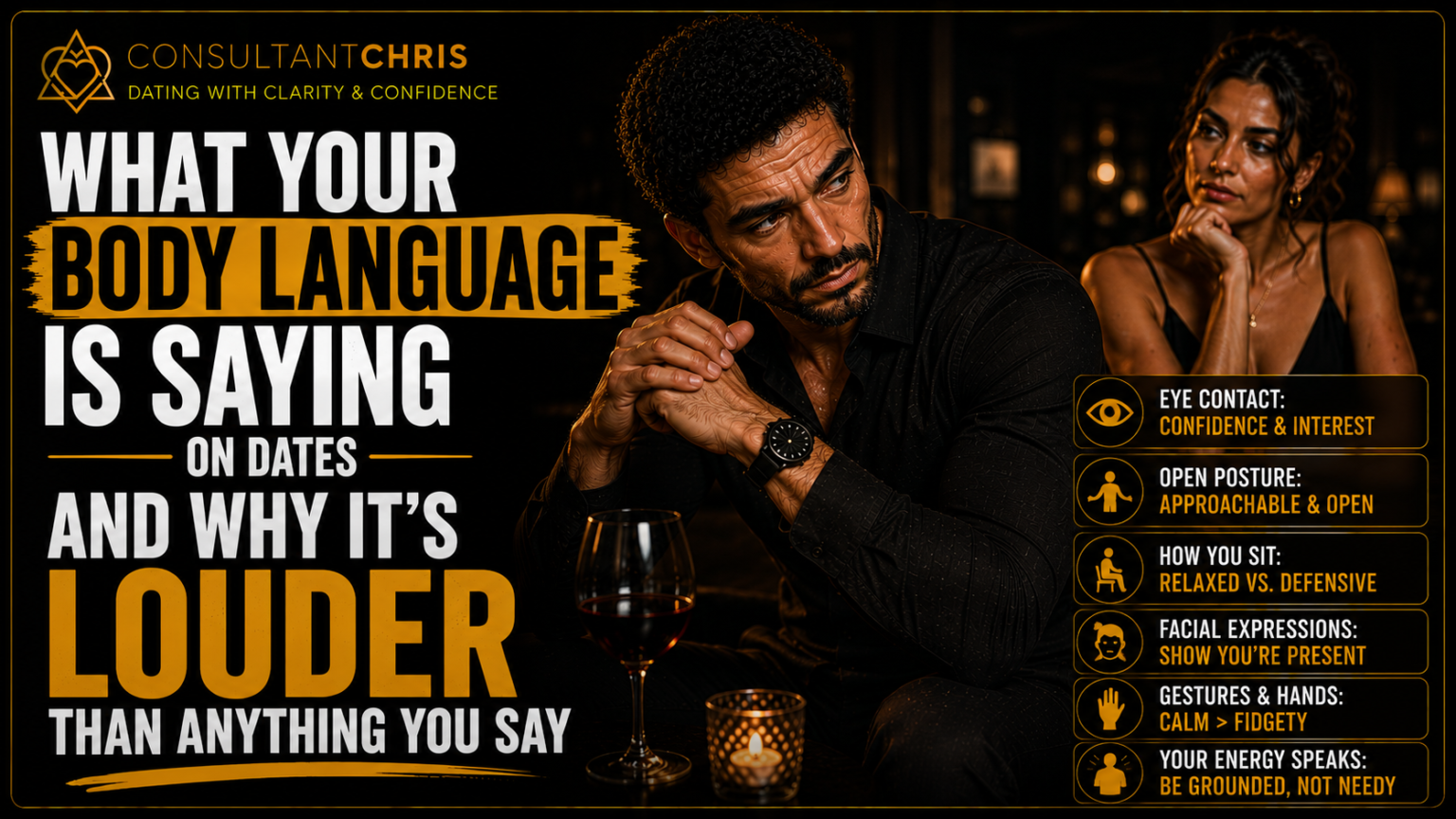
Here’s something I’ve witnessed in more in-person coaching sessions than I can count.
A man walks into a coffee shop for a date. Decent-looking guy. Dressed well. He’s mentally rehearsed some conversation topics. And from the moment he sits down, his body is broadcasting a completely different message to the one his words are trying to send. Shoulders hunched slightly forward. Eyes darting rather than holding contact. Hands restless on the table. Voice just a half-step too fast, a half-pitch too high. His words say ‘I’m confident and interested.’ His body says ‘I’m not quite sure I should be here.’
She feels it immediately. she’s not running a checklist of body language cues. Her nervous system is simply picking up information that has been available to humans for tens of thousands of years before verbal language got involved. And that information is making her feel a specific way about this interaction that no amount of good conversation is going to fully override.
Understanding this isn’t about learning performance techniques. It’s about understanding what your body is actually communicating and then doing the internal work that makes the external signals authentic.
What the Research Actually Shows
There’s a famous 1971 study by UCLA psychologist Albert Mehrabian that people often misquote as saying words are only 7% of communication. The actual finding is more nuanced, it specifically addresses the communication of feelings and attitudes, and shows that when words and nonverbal signals conflict, people believe the nonverbal signals.
More precisely relevant to dating: a 1992 study called ‘Thin Slices of Behavior’ found that people could accurately judge a stranger’s emotional state and competence from just a few seconds of silent video. No words. Just what they see.
And a 2006 study showed that people made consistent judgments of trustworthiness and likeability from facial exposure of as little as 100 milliseconds, literally one tenth of a second.
Women are not consciously processing all of this. Their nervous system is doing it automatically. Which means that long before you’ve opened your mouth on a date, she has already registered an impression and everything you say is either building on that foundation or working against it.
The Specific Signals That Matter Most

Posture
Upright, relaxed posture with open chest and shoulders back communicates stability and presence. Hunched or collapsed posture registers as insecurity, not just aesthetically, but at the level of what it signals about your comfort with yourself. You don’t need to sit like a soldier. You need to be grounded. Feet flat on the floor, back in contact with the chair, shoulders naturally back and down rather than pulled up toward your ears.
Eye Contact
This is the single most impactful nonverbal signal in initial attraction and sustained connection. Steady, warm eye contact communicates presence and genuine interest. Darting eyes communicate anxiety or disengagement. The most common mistake I see with men who struggle in dating is eyes that aren’t there looking slightly away, looking at the table, looking past her. She experiences that as you not being fully present, even when you are.
Calibrated eye contact isn’t a stare. It’s a natural hold, making and maintaining contact when she’s speaking, holding it when you’re making a point that matters, letting it soften rather than intensify. The goal is that she feels seen, not studied.
Voice
Speed and pitch are both anxiety signals. A voice that speeds up when nerves kick in, or rises slightly in pitch, communicates exactly what you’re trying to hide. The practical fix is breathing, specifically, exhaling fully before responding to something. One complete breath slows everything down and grounds the voice in your chest rather than your throat. Speaking from the diaphragm rather than the throat produces a naturally lower, more resonant sound that communicates calm authority.
Facial Expression
A face that’s alive, that actually responds to what’s being said with real micro-expressions of amusement, interest, warmth, curiosity is enormously more attractive than a face that’s managed to neutrality. Men who are nervous or self-monitoring often go flat-faced without realising it. The emotional suppression they’re doing internally produces a mask externally. Let your face respond genuinely to the conversation. If something is funny, let it register. If something she says is interesting, let that show.
Calibration
The most sophisticated body language skill and the one most directly connected to emotional intelligence is calibration. Matching the energy of the interaction to what’s actually happening rather than what you planned for. If she’s warm and playful, there’s space to be lighter. If she seems reserved or thoughtful, slowing down and being more deliberate matches her register and makes her feel understood rather than steamrolled. Think of Serena Williams before a serve she doesn’t force the moment, she reads it and finds her rhythm within it.
The Internal Fix for External Signals

Here’s the thing about body language that the ‘fake it till you make it’ crowd misses: forced confidence signals are detectable. A performed posture that doesn’t match your internal state creates incongruence — and incongruence is what people are actually picking up on when something feels ‘off’ about someone even though they can’t articulate why.
The genuine fix is internal. When your body language is working well on a date, it’s almost always because you’re actually present you’ve managed to quiet the self-monitoring and actually be in the conversation rather than watching yourself be in it. That internal state produces the external signals naturally, without performance.
The practical drills that build this: the grounding breath before you walk in (four counts in, hold for four, six counts out). The daily practice of making steady eye contact with anyone you interact with cashiers, colleagues, anyone to rewire the association between eye contact and threat. And the fundamental EQ work of developing enough self-regulation that you can stay present in a high-stakes interaction without the anxiety running your body.
Your body has been speaking this whole time. The question is whether you know what it’s been saying.
Words matter less than most men assume once you notice this. Eye contact is one of the clearest signals you control, and it plays directly into common first date mistakes.
