


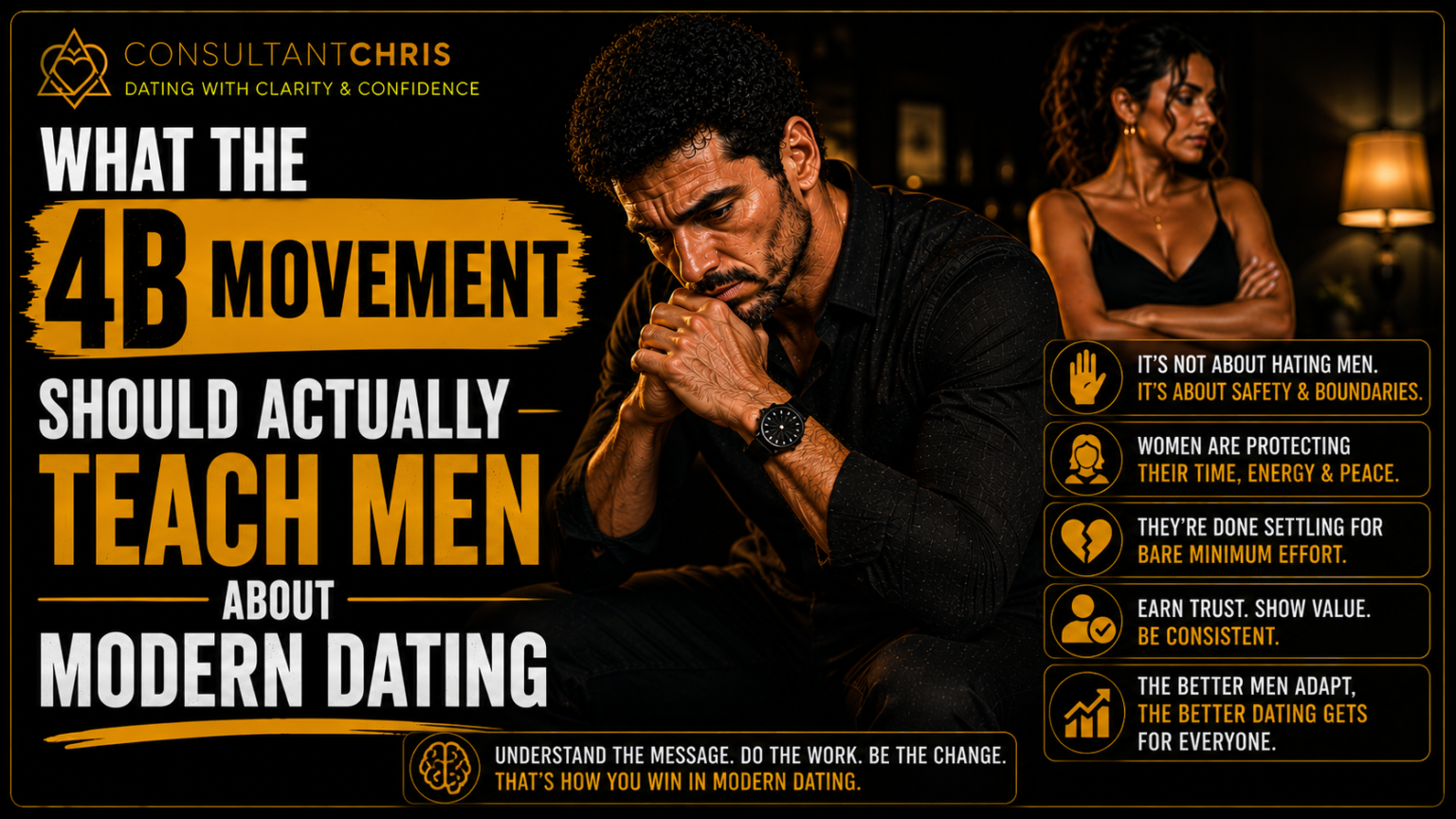
There’s a movement that originated in South Korea and has been spreading globally particularly gaining traction in online spaces frequented by women frustrated with modern dating, that I think deserves an honest, non-defensive examination from men.
The 4B movement advocates for women refusing four things: dating men (biyeonae), marriage to men (bihon), sex with men (bisekseu), and bearing children (bichulsan). It’s a radical position, and the version of it that’s been gaining attention in Western contexts isn’t necessarily as absolute as the Korean original. But the energy behind it the frustration, the exhaustion, the sense that the current dynamic isn’t working, is real, and dismissing it or getting defensive about it is the least useful thing a man can do.
I want to talk about what this movement is actually telling us. Because underneath the provocative framing is a set of very specific criticisms that, if you’re willing to hear them without ego, point directly at things that emotionally intelligent men should already be working on.
What Women in This Space Are Actually Saying

The women who are drawn to the 4B position or to the broader sentiment it represents — are not, in the main, expressing hatred of men. They’re expressing exhaustion with a specific pattern they’ve experienced repeatedly.
That pattern, when you aggregate the conversations happening in these spaces, comes down to a few consistent themes. Emotional labour the sense that in heterosexual relationships, women are consistently carrying the emotional weight for both people. Communication gaps the experience of being with men who can’t or won’t engage with emotional content in a relationship. The persistent feeling of being unseen or unheard. The exhaustion of being in relationships where they feel more like a support system for a man than an equal partner.
Now and this is important, not all of these criticisms apply to all men, and some of the discourse in these spaces has moved well past productive critique into something more generalising and less useful. I’m not endorsing the movement as policy. I’m saying: take the underlying signal seriously, even if the form it takes is extreme.
Because the underlying signal is consistent with everything the research shows about what women are looking for in partners right now. Tinder’s 2026 data shows 56% of daters prioritising honest conversation and 45% wanting more empathy from partners. Pew Research confirms that men are less likely than women to reach out for emotional support outside of their romantic partner, which means they’re placing an enormous emotional load on one person. These patterns are real, they’re documented, and they have consequences.
The Emotional Labour Question
Let me address this directly, because it’s the most consistent complaint and the one that connects most clearly to what I work on with men.
Emotional labour, in the relational sense, refers to the work of managing the emotional climate of a relationship initiating meaningful conversations, tracking the emotional state of both people, recognising when something needs to be addressed and raising it, maintaining the emotional connection through regular investment. In heterosexual relationships, research consistently shows this work falls disproportionately to women.
Part of this is structural women have historically been socialised to develop emotional skills that men haven’t been encouraged to develop. This isn’t a moral failing of individual men. It’s a training gap produced by a culture that rewarded different things from boys and girls.
But ‘it’s not your fault it happened’ is not the same as ‘it’s not your responsibility to address it.’ The men who are most successful in relationships with strong, emotionally intelligent women in 2026 are the ones who can carry their own emotional weight who initiate meaningful conversations, who notice when something in the relationship needs attention, who don’t need their partner to manage their emotional experience for them.
That’s not a high bar in principle. It requires the development of exactly the emotional intelligence skills I teach — self-awareness, self-regulation, empathy, and the social attunement that lets you read what a relationship needs and respond to it.
What to Do With This Information

I want to be clear about what I’m not saying. I’m not saying the 4B movement is correct in its prescription. I’m not saying men are the problem and women are blameless. Relationships are co-created, and the dynamics that frustrate women in dating are not entirely generated by men.
What I am saying is that a significant number of women, particularly educated, emotionally intelligent, professionally established women are reaching a point of frustration with the emotional availability gap in dating, and are voting with their choices. That’s worth taking seriously.
The men who respond to this information with defensiveness or dismissal ‘women just have too high standards now’ are positioning themselves to have less and less access to exactly the women they want to connect with.
The men who respond with genuine reflection ‘what does this tell me about what I need to develop?’ — are positioning themselves to be exactly what emotionally intelligent women are looking for and increasingly struggling to find.
The 4B movement isn’t a threat. It’s a signal. And the message is: develop your emotional intelligence or get left behind. Fortunately, that’s entirely within your control.
This movement is worth understanding rather than dismissing. It connects closely to modern gender roles shifting underneath everyone, and to what women are actually saying they want right now.
